

The Hidden Revenue in Your Dormant Customer Base
AI Reactivation Campaigns are strategic, automated outreach efforts that use artificial intelligence to re-engage inactive customers and leads through personalized, timely communications.
Here’s what you need to know about AI reactivation campaigns:
| AI Reactivation Campaign Elements | Benefits |
|---|---|
| Personalized messaging | Increases response rates by up to 34% |
| Predictive timing | Delivers messages when customers are most likely to engage |
| Multi-channel approach | Reaches customers where they’re most responsive |
| Automated follow-up | Saves time and reduces manual effort |
| Behavioral triggers | Responds to specific customer actions or inactions |
Every business faces the challenge of dormant leads—those once-promising prospects that went cold. Studies show that reactivating existing customers is five times cheaper than acquiring new ones, yet many companies leave this revenue untapped. The power of AI reactivation campaigns lies in their ability to transform these forgotten leads into active customers through intelligent, data-driven engagement.
“Over the last 45 days, one company was able to lower churn by over 40% thanks to AI-powered cancellation surveys and win-back offers.”
Dormant leads are not dead ends—they’re untapped opportunities. These contacts have already shown interest in your products or services, making them more valuable than cold prospects. With the right approach, they can become your most profitable customers.
I’m Samir ElKamouny, founder of FetchFunnel.com, and I’ve personally helped countless businesses implement AI Reactivation Campaigns that have transformed dormant databases into revenue-generating assets. My experience building data-driven customer journeys has shown that strategic reactivation is often the highest-ROI marketing activity available.

What You’ll Learn
In this comprehensive guide, you’ll find:
– How to identify and segment your dormant leads for maximum reactivation potential
– Step-by-step instructions for building effective AI reactivation campaigns
– Strategies for personalizing outreach across multiple channels
– How to measure success and scale what works
– Real-world examples of businesses that have successfully reactivated customers
Whether you’re a small business owner or a marketing professional at a large corporation, this guide will equip you with practical, actionable strategies to recapture lost revenue and turn dormant leads into active customers again.
AI Reactivation Campaigns Explained
AI reactivation campaigns represent a significant evolution from traditional customer win-back efforts. At their core, these campaigns leverage artificial intelligence and machine learning to identify, target, and re-engage customers who have become inactive or disengaged from your business.

Remember the days of sending generic “We miss you!” emails to everyone who hadn’t purchased in 90 days? Those traditional reactivation methods feel almost quaint now. They typically involved mass email blasts, one-size-fits-all messaging, and standard discount offers that didn’t account for individual customer history. Not only were these approaches labor-intensive, but they also offered limited scalability and personalization.
Today’s AI reactivation campaigns have completely transformed this landscape:
| Traditional Reactivation | AI-Powered Reactivation |
|---|---|
| Manual outreach | Automated, intelligent engagement |
| Generic messaging | Hyper-personalized communication |
| Fixed timing | Optimal timing based on user behavior |
| One-size-fits-all offers | Custom incentives based on customer value |
| Single-channel approach | Coordinated multi-channel strategy |
| Limited scale | Unlimited scalability |
| Reactive | Predictive and proactive |
The results speak volumes. While traditional methods might yield single-digit response rates, AI reactivation campaigns can win back up to 34% of former customers through perfectly timed, personalized offers.
I recently spoke with a gym owner in North Carolina who was blown away by her results. Her AI reactivation campaign targeting dormant members achieved a 7% positive response rate and generated over $83,000 in revenue from what she had written off as “dead leads.” That’s the power of intelligent reactivation at work!
How AI Reactivation Campaigns Differ from Legacy Tactics
The magic of AI reactivation campaigns lies in their intelligence and adaptability. While legacy tactics operate on static rules and broad assumptions, AI approaches continuously learn and optimize with every interaction.
What makes these campaigns truly is their ability to think ahead. Predictive analytics forecast which dormant customers are most likely to return and what specific offers will resonate with them. Rather than blasting everyone with the same message on the same day, AI activates campaigns based on specific customer behaviors that signal receptiveness.
Perhaps most impressively, these systems continuously learn from results, automatically adjusting messaging, timing, and offers to improve performance. The days of siloed channel approaches are gone too – AI orchestrates seamless experiences across email, SMS, social media, and other touchpoints where your customers actually spend their time.
One of our finance clients implemented AI reactivation campaigns and saw a 16% response rate from what they considered dead leads. This resulted in 13 sales from just 100 contacts. When scaled to 300 leads, they generated $37,000 in revenue that would have otherwise disappeared into the void. That’s real-time adaptation at work!
Why Dormant Leads & Inactive Customers Are Goldmines
I often tell clients that while they’re spending thousands chasing new customers, they’re sitting on a goldmine of dormant leads. This oversight represents one of the biggest missed opportunities in modern marketing.
Here’s the truth: reactivating an existing customer costs approximately 5x less than acquiring a new one. Think about it – your dormant leads have already entered your funnel, recognized your brand, and shown initial interest. You’ve already done the hard part!
These contacts have previously engaged with your business, making them far more likely to convert than cold prospects. You already possess valuable data about them – their preferences, behaviors, and interaction history – enabling truly personalized outreach that resonates.
The numbers tell a compelling story. Brands lose an average of 25% of their email list each year, and between 25-50% of customers become inactive annually. Yet a mere 5% increase in customer retention can increase profits by 25-95%. Even more striking: the probability of selling to an existing customer is 60-70%, compared to just 5-20% for new prospects.
A retail client of ours used AI reactivation campaigns to send personalized discount codes to leads who abandoned their carts. The result? A 25% increase in conversions within a week – revenue that would have otherwise vanished into thin air.
When you consider the higher lifetime value and lower acquisition costs of reactivated customers, it becomes clear that your dormant database isn’t just a list of contacts – it’s an untapped revenue stream waiting to be activated with the right approach.
Building Your First AI Reactivation Campaign
Ready to breathe new life into those dormant leads? Building your first AI reactivation campaign doesn’t have to be complicated. With the right approach, you’ll create a system that continuously identifies, engages, and converts inactive contacts with minimal effort on your part.
Before diving into the technical details, take a moment to clarify what you want to achieve. Are you hoping to boost customer retention? Recover abandoned carts? Re-engage email subscribers who’ve gone silent? Reactivate lapsed subscriptions?
Your specific goals will shape everything from how you segment your audience to the messages you send and how you measure success.

Step 1: Segment & Prioritize Your Database
Not all dormant leads are created equal. Some were once your biggest fans, while others barely engaged before disappearing. Effective segmentation recognizes these differences.
Start by defining what “inactive” means for your business. For an e-commerce store, it might be customers who haven’t purchased in 3+ months. A SaaS company might look at users who haven’t logged in for 30+ days. Content publishers might focus on subscribers who haven’t opened emails in 60+ days.
Once you’ve established these thresholds, dig deeper into your data. Group your dormant contacts based on their past behavior and value. Look at how recently they engaged, how frequently they purchased, and how much they spent (RFM analysis). Consider their behavior before they went quiet—were they browsing specific products? Did they abandon a cart? Were they seasonal buyers?
When possible, try to understand why they disengaged. Did they complete their goal with your product? Did their seasonal needs end? Did they have a negative experience?
I worked with a fitness business that smartly tested their AI reactivation campaign on just 100 dormant leads before rolling it out. That small test yielded a 20% engagement rate and provided valuable insights for their full campaign to 15,000 contacts. Sometimes starting small leads to the biggest wins!
Step 2: Choose the Right AI Stack & Integrate
The technology you select will make or break your reactivation efforts. You need tools that talk to each other seamlessly while providing the intelligence to make your campaigns truly personalized.
At the heart of your tech stack should be a robust Customer Data Platform (CDP) that unifies information from all your sources. This gives you that coveted 360-degree view of each customer’s journey—essential for meaningful reactivation.
You’ll want to pair this with AI-powered marketing automation that can learn from customer behaviors and optimize everything from send times to content selection. Add in some predictive analytics to identify which dormant customers are most likely to return, and you’ve got a powerful foundation.
Don’t overlook conversational AI tools like chatbots. They can engage returning customers in natural dialogue, answer questions, and even help complete transactions when someone does decide to come back.
Most importantly, make sure everything connects to your CRM through solid API connections. Your sales team needs visibility into these reactivation efforts to provide seamless follow-up.
One of our B2B clients implemented AI-driven lead scoring that highlighted which dormant contacts were showing renewed interest. This helped their sales team focus on the most promising opportunities, increasing demo sign-ups by 20%. Sometimes knowing who to call first makes all the difference!
Step 3: Craft Value-Driven Messaging & Offers
Generic “We miss you” emails just don’t cut it anymore. Your reactivation messages need to deliver clear value and compelling reasons to re-engage.
The most effective AI reactivation campaigns use personalized messaging that speaks directly to the customer’s previous relationship with your brand. Whether it’s an incentive-based approach (“Here’s 20% off your next purchase”), a value reminder (“Remember why you loved our weekly meal plans?”), or creating a sense of FOMO (“You’ve missed our last 3 exclusive member events”), the key is relevance.
Sometimes simplicity works wonders. The “9-word email” approach—a short, personal message like “Are you still interested in improving your conversion rates?”—can cut through inbox clutter and generate surprising response rates.
This is where AI truly shines. It can dynamically select the most effective message type for each recipient, personalize content based on their history, test multiple variations to find winners, and adjust offers based on customer value.
One online retailer we worked with saw email open rates jump by 40% after implementing AI reactivation campaigns with personalized subject lines and content. They re-engaged over 5,000 dormant leads in just three months. The right message really does make all the difference!
Step 4: Orchestrate Multi-Channel Outreach
The days of single-channel marketing are behind us. Today’s most effective AI reactivation campaigns coordinate outreach across multiple touchpoints, meeting customers wherever they’re most likely to engage.
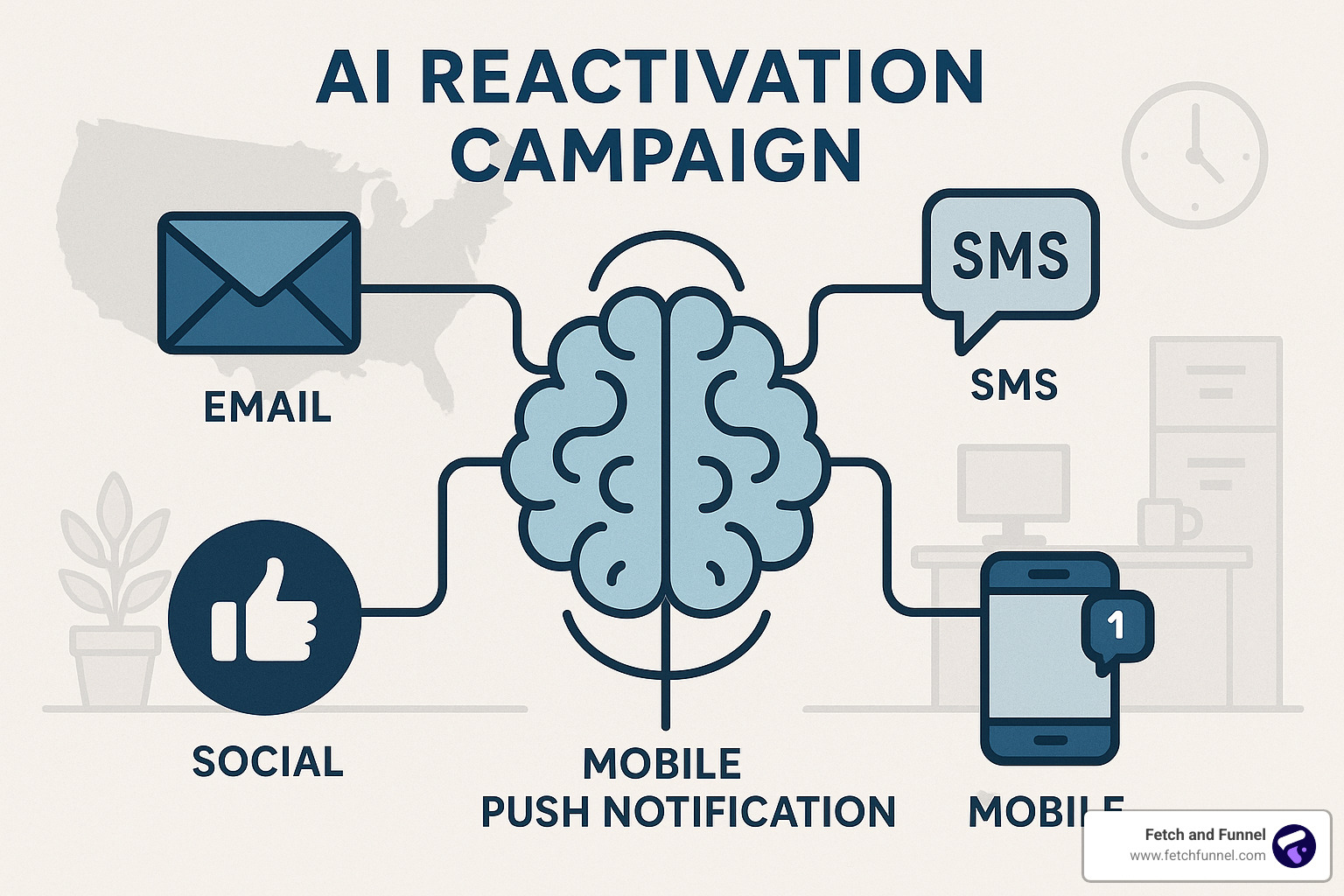
While email remains the backbone of most reactivation efforts, adding SMS messages (with their impressive 95%+ open rates) can dramatically boost your results. Push notifications work wonders for mobile app users, while social media retargeting can keep your brand top-of-mind as dormant customers browse Facebook or Instagram.
For high-value customers, consider mixing in direct mail or even phone outreach. A physical postcard or a personal call can create a memorable impression that digital channels simply can’t match.
The magic happens when these channels work together harmoniously. Your messages should maintain consistent themes while adapting to each channel’s strengths. The sequence of touchpoints should adjust intelligently based on customer responses, and you should always respect frequency caps to avoid channel fatigue.
Scientific research on triggered messages has found that behavior-triggered messages can be up to 2,770% more effective than batch messages. Timing and relevance truly matter!
At Fetch and Funnel, we’ve seen remarkable results by combining email reactivation with targeted social media ads. This approach has helped our clients double their reactivation rates compared to email-only campaigns. When channels work together, dormant leads don’t stand a chance!
Want to learn more about optimizing your customer journeys? Check out our guide to Conversion Rate Optimization Best Practices for additional insights.
Personalization, Timing & Channel Optimization
The magic of AI reactivation campaigns isn’t just in their automation—it’s in their ability to deliver perfectly custom messages exactly when and where your customers are most receptive. Before AI, this level of precision marketing was just a dream. Now, it’s an everyday reality that’s changing how brands reconnect with dormant customers.
How AI Chooses the Perfect Moment to Engage
Have you ever received a marketing message at exactly the right moment and thought, “Wow, that’s exactly what I needed right now”? That’s not coincidence—it’s AI working behind the scenes to find your perfect engagement window.
AI reactivation campaigns analyze complex patterns in customer behavior to determine optimal timing through:
When a payment app implemented our AI-driven timing optimization, they saw dormant user reactivation jump by 37%—simply by sending push notifications during individually optimized windows rather than batch sending. Another client achieved a remarkable 40% lift in email open rates by letting AI determine the perfect send time for each recipient.
But timing isn’t just about the hour of day. Our AI systems can detect behavioral triggers like a sudden website visit after months of inactivity, a cart abandonment, or even major life events that signal prime reactivation opportunities. These moments of receptivity are gold for reconnecting with customers who’ve drifted away.
Channel Mix That Converts
We all have our preferred ways to communicate, and those preferences can shift depending on our mood, location, and the time of day. The beauty of AI reactivation campaigns is their ability to adapt to these changing preferences.
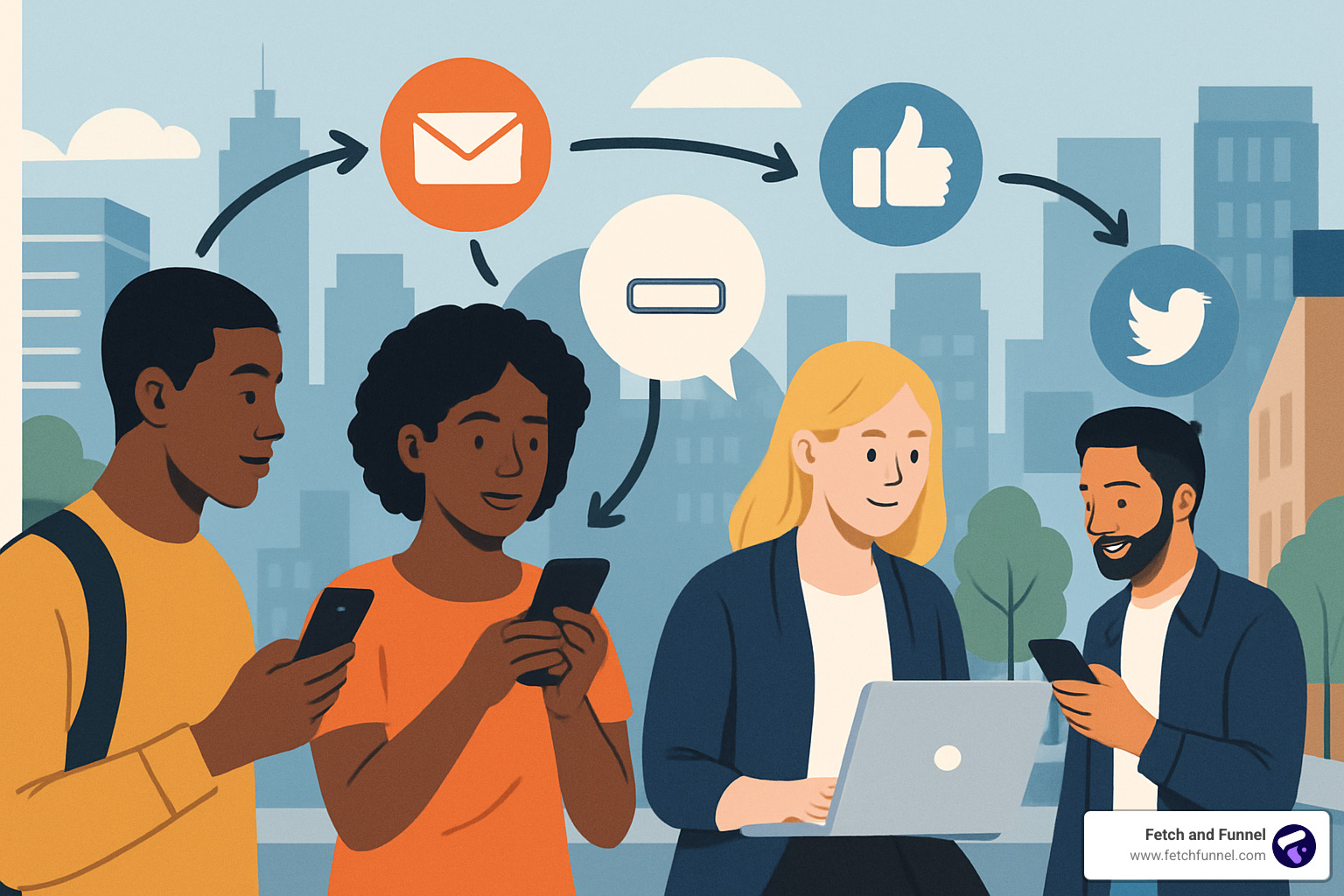
One of our retail clients finded something fascinating when we implemented channel optimization: their dormant customers under 30 responded best to Instagram retargeting followed by SMS, while those over 45 preferred email followed by Facebook. By automatically routing messages through the optimal channel sequence for each age segment, they boosted conversion rates by 32%.
AI creates this channel harmony through:
Channel affinity analysis that reveals which platforms each customer naturally gravitates toward, whether that’s email, SMS, social media, or push notifications.
Intelligent routing that considers not just preference but context—sending urgent offers via text, detailed product information via email, and visual inspiration through social channels.
Cross-channel journeys that move customers through a thoughtful sequence, perhaps starting with a gentle email reminder, followed by social retargeting, and culminating in a special offer via their preferred channel.
Custom incentives that match both the channel and the customer—because the offer that works in an email might need adjustments to perform well as an SMS or social ad.
Maintaining the Human Touch
While we love technology at Fetch and Funnel, we’ve learned that the most successful AI reactivation campaigns never lose sight of the human connection. After all, you’re not just reactivating accounts—you’re rebuilding relationships.
Handoff rules are essential guardrails that ensure high-value customers or complex situations get personal attention from your team. Your AI should know when to pass the baton to a human, whether that’s for your VIP customers or when someone responds with a question the system can’t adequately address.
Brand voice and empathy need to shine through every automated message. We help our clients create guidelines that ensure their AI communications feel authentic and emotionally intelligent. This means acknowledging your history together, expressing genuine appreciation, and avoiding robotic language that creates distance.
Deep personalization goes far beyond inserting a first name. True connection happens when you reference specific purchases, acknowledge relationship milestones, or tailor content to individual interests. One of our clients saw response rates double when they moved from basic personalization to these deeper, more meaningful touches.
At Fetch and Funnel, we’ve found the sweet spot isn’t choosing between AI efficiency and human warmth—it’s blending them seamlessly. The best AI reactivation campaigns handle the complex work of personalization, timing, and channel selection while preserving the authentic connection that only your brand can create.
More info about Ecommerce Email Marketing Agency
Tracking Success & Scaling What Works
Let’s be honest – launching your AI reactivation campaigns is just the beginning of your journey. The real magic happens when you track results, learn what’s working, and scale those winning strategies across your business.
Dashboards & Metrics That Matter
When it comes to measuring success, not all metrics are created equal. Focus on these powerful indicators that truly show the impact of your reactivation efforts:
Your reactivation rate is the north star metric – this shows the percentage of dormant customers who’ve come back to life after receiving your campaign. Successful campaigns typically see anywhere from 5-34% of customers returning to the fold. Calculate this by dividing your reactivated customers by total dormant customers targeted, then multiply by 100.
Beyond this fundamental metric, pay attention to your Cost Per Reactivation (CPR). This tells you exactly how much you’re spending to win back each customer. When you compare this to your standard Customer Acquisition Cost, the value proposition often becomes crystal clear – reactivation is typically far more cost-effective than finding brand new customers.
But don’t stop there. The true measure of success is the Reactivated Customer Value (RCV) – how much revenue these customers generate after coming back. Track both their immediate purchases and their spending over 3, 6, and 12 months. This longer-term view helps you understand if you’re bringing back quality customers or just one-time bargain hunters.
“We had a client who finded their reactivated customers were actually spending 20% more than their average customer in the six months following reengagement,” shares our data team at Fetch and Funnel. “This completely transformed how they valued their dormant database.”
Your dashboard should also highlight channel performance across email, SMS, social ads and other touchpoints, along with time-to-reactivation metrics and post-reactivation retention rates. These insights help you refine your approach over time, doubling down on what works and adjusting what doesn’t.
Common Pitfalls & How to Avoid Them
Even the most sophisticated AI reactivation campaigns can hit unexpected roadblocks. Here are the pitfalls we see most often and how to steer clear of them:
Data quality issues can undermine even the most brilliant AI strategy. Garbage in, garbage out applies perfectly here. Implement regular data cleaning processes, validate contact information before campaigns launch, and use every customer interaction as an opportunity to refresh your data.
Compliance violations are another dangerous trap. Nothing kills a reactivation campaign faster than running afoul of GDPR, CCPA, or CAN-SPAM regulations. Ensure you have proper opt-in records, clear unsubscribe options, and channel-specific consent (especially for SMS). When in doubt, document everything.
Message fatigue happens when your enthusiasm for reactivation overwhelms your customers with too many touchpoints. Use AI to identify the optimal contact frequency for each customer and implement cross-channel frequency caps. Watch for negative signals like unsubscribes or complaint rates, and adjust accordingly.
Many businesses struggle with channel coordination, sending disjointed messages that create a fragmented customer experience. Centralize your campaign management in a single platform and ensure consistent messaging across all touchpoints. Your customers should feel like they’re having one continuous conversation with your brand, not receiving random communications.
Finally, beware the discount dependency trap. While promotions can drive quick wins, overreliance on deep discounts conditions customers to wait for sales before engaging. Test value-driven alternatives like exclusive content, early access to new features, or community benefits. When discounts are necessary, use AI to offer the minimum effective incentive for each customer segment.
When & How to Rinse-and-Repeat at Scale
Once you’ve found reactivation approaches that work, it’s time to amplify your success. Here’s how to scale effectively without sacrificing performance:
Accept iterative improvement by starting small and expanding based on results. Run targeted tests before full deployment, implement A/B testing for key variables, and let your AI identify patterns that might escape human observation. Each campaign should inform and improve the next.
Gradually expand your automation capabilities, starting with basic segmentation and timing optimization before progressing to fully personalized content generation and sophisticated cross-channel orchestration. This crawl-walk-run approach ensures your team can adapt alongside your technology.
When it comes to segment expansion, patience pays off. Begin with your most promising dormant customers (recently inactive, high previous value) before tackling more challenging segments. Develop specialized approaches for different customer types rather than using a one-size-fits-all strategy.
For larger organizations, geographic and business unit scaling requires careful coordination. Document successful approaches as templates, adapt messaging to local market conditions, and maintain centralized oversight while enabling local customization. Create systems for sharing learnings across teams to accelerate improvement company-wide.
The most sophisticated reactivation programs implement continuous learning systems where AI models get smarter with each campaign. Feed results back into training data, allow models to self-optimize based on performance, and develop increasingly nuanced customer segments over time.
The potential impact is substantial. One of our insurance clients with 15,000 dormant leads achieved a 20% engagement rate and projected 5% conversion rate using AI reactivation campaigns. That translated to approximately 150 new sales from what was considered a “dead” database – all while maintaining these impressive metrics as they scaled to their full contact list.
Latest research on churn recovery confirms what we’ve seen at Fetch and Funnel: systematic reactivation efforts often represent the highest-ROI marketing activity available to growth-focused businesses.
Frequently Asked Questions about AI Reactivation Campaigns
Is AI too expensive for small businesses?
The good news? AI reactivation campaigns are no longer just for companies with massive budgets. Today’s AI landscape offers solutions for businesses of all sizes, from solopreneurs to enterprise organizations.
Many small business owners I’ve worked with initially worry about costs, but quickly find that implementing AI doesn’t require a complete technological overhaul. Most can start by leveraging AI features already built into their current marketing tools. Your existing email platform or CRM likely offers AI-powered send time optimization or content suggestions that can dramatically improve your reactivation efforts without additional investment.
If you’re just getting started, consider a focused approach. Rather than implementing a comprehensive AI solution all at once, start with the specific capabilities that address your biggest reactivation challenges. Need better email open rates? Try AI subject line optimization. Struggling with timing? Implement send-time prediction.
Remember to view AI as an investment rather than an expense. When a gym owner in North Carolina launched their first AI reactivation campaign, they generated over $83,000 in revenue from dormant leads with a relatively modest technology investment. The math often makes the decision easy – even a small improvement in reactivation rates can deliver significant ROI.
How do I stay GDPR/CCPA compliant?
Navigating privacy regulations while running AI reactivation campaigns doesn’t have to be intimidating. At Fetch and Funnel, we’ve helped many clients implement compliant reactivation strategies that respect both legal requirements and customer preferences.
Compliance starts with good record-keeping. Maintain clear documentation of when and how each contact opted into your communications. This becomes your permission foundation for reactivation outreach. Consent isn’t forever – many jurisdictions have specific timeframes after which you’ll need fresh permission.
Every message you send should include straightforward, one-click unsubscribe options. This isn’t just a legal requirement; it’s also good customer experience. People appreciate control over their inbox, and respecting their preferences builds trust.
Be thoughtful about data collection. The “collect everything just in case” approach is outdated and potentially problematic. Instead, focus on gathering only the information truly necessary for your reactivation efforts. This minimizes both compliance risks and data management headaches.
The inner workings of your AI deserve attention too. Document how your algorithms make decisions about customer communications, especially if you’re using advanced personalization. This transparency helps demonstrate responsible AI use if questions arise.
With different rules across regions, geo-specific approaches may be necessary. We often implement location-based rule sets that automatically adjust messaging and data handling based on where your contacts reside.
Finally, schedule regular compliance check-ups. Privacy regulations evolve, and your reactivation processes should evolve with them. A quarterly review helps catch potential issues before they become problems.
Will AI replace my sales team?
I hear this concern often, and I can confidently say: AI reactivation campaigns improve your sales team’s effectiveness rather than replacing them. The most successful reactivation strategies we’ve implemented at Fetch and Funnel combine AI efficiency with human relationship-building.
Think of AI as handling the groundwork. It excels at managing initial outreach, identifying which dormant leads show renewed interest, and maintaining consistent follow-up schedules. This automation of routine tasks means your sales professionals can focus their valuable time and emotional intelligence where it matters most – building relationships and closing deals.
The intelligence that AI provides becomes a powerful tool in your sales team’s arsenal. When a dormant lead suddenly visits your pricing page after months of inactivity, AI can alert your team and provide context about that prospect’s history and interests. This creates opportunities for timely, informed outreach that feels remarkably personal to the customer.
While AI excels at data processing and pattern recognition, humans still dominate in crucial areas like handling complex objections, negotiating custom solutions, and building authentic connections. The emotional intelligence your team brings to conversations remains irreplaceable.
One of our B2B clients saw this partnership in action when they implemented AI-driven lead scoring as part of their reactivation strategy. Their sales team’s demo sign-ups increased by 20%, not because AI replaced anyone, but because their human talent was now focused on the most promising opportunities the AI identified.
The most effective arrangement is a continuous improvement loop where your sales team’s insights help train the AI to better identify promising reactivation opportunities, while the AI provides increasingly valuable intelligence to support your team’s conversations.
Human Human
AI’s role is to make your sales team more effective, not obsolete. The combination of technological efficiency and human connection creates reactivation results neither could achieve alone.
Conclusion
AI reactivation campaigns represent one of the most exciting opportunities for businesses today. There’s real gold in your existing database – dormant customers who already know and trust your brand, just waiting for the right message to come back.
The results we’ve seen at Fetch and Funnel speak for themselves. That gym owner in North Carolina who generated $83,000 from “dead leads.” The finance company that turned 100 dormant contacts into $37,000 in new revenue. These aren’t outliers – they’re what happens when you apply intelligent reactivation strategies to forgotten customers.
The future looks even brighter as these technologies continue to evolve:
Generative AI is changing how we create personalized messages. Instead of template-based communications, we can now craft messages that feel genuinely human and uniquely relevant to each recipient. The days of generic “We miss you!” emails are behind us.
Predictive intent modeling takes personalization even further. Beyond just knowing who might respond, AI can increasingly predict exactly what offer will resonate with each dormant customer. One person might need a discount, while another simply needs to know about your new features.
Omnichannel orchestration is becoming seamless and natural. Your customers don’t think in terms of “channels” – they just want a consistent experience whether they’re seeing your email, text message, or social media ad. AI makes this possible at scale.
Emotion AI represents the next frontier. Understanding not just what customers do, but how they feel, enables even more meaningful reconnections. Sometimes the right message isn’t about features or discounts – it’s about addressing an emotional need.
At Fetch and Funnel, we’re helping Boston businesses and beyond implement these innovations in practical, results-driven ways. We don’t chase technology for its own sake – we focus on the measurable impact it can have on your bottom line.
Every day that passes without an AI reactivation strategy means potential revenue left on the table. These aren’t cold leads you’re trying to convince – they’re people who have already shown interest in what you offer.
Ready to turn your dormant database into your most valuable asset? Learn more about our Data-Driven Customer Engagement services and find how we can build AI reactivation campaigns custom specifically to your business needs.
Remember: Your dormant customers haven’t forgotten you – they just need the right nudge at the right moment to come back. With AI-powered reactivation, you can deliver exactly that personal touch, at exactly the right time, through exactly the right channel.


