

Maximizing Patient Acquisition Through Digital Optimization
Ever wonder why some healthcare websites turn visitors into patients while others just… don’t? That’s where the magic of conversion rate optimization for healthcare comes in.
At its heart, this is about changing your digital presence into a patient-generating machine. It’s the art and science of improving how effectively your medical website or landing pages convert visitors into actual appointments, form submissions, or consultation requests.
The healthcare landscape has changed dramatically. Today’s patients research their options carefully before making that first call. Your website isn’t just an online brochure—it’s often your first chance to make a meaningful connection.
Here’s what we’re seeing work right now for medical practices:
| CRO Strategy | Potential Impact |
|---|---|
| Simplify appointment booking forms | Reducing fields from 11 to 4 can improve conversions by 120% |
| Optimize for mobile users | 32% of appointments are now booked online (up from 2.4% in 2015) |
| Add trust signals (certifications, reviews) | 94% of patients read online reviews before choosing a provider |
| Implement A/B testing | Proper testing can boost healthcare conversion rates by 200-500% |
Most healthcare websites convert around 3% of visitors, while focused medical service landing pages average about 7.4%. But these are just averages—with thoughtful optimization, your practice can do significantly better.
The challenge? Healthcare isn’t selling shoes or subscription boxes. You’re dealing with people’s wellbeing, often when they’re worried or in pain. You need to build trust and convey expertise while navigating complex privacy regulations like HIPAA. It’s a delicate balance of compelling marketing and ethical responsibility.
I’ve seen this firsthand. I’m Samir ElKamouny, founder of Fetch and Funnel, and I’ve helped numerous healthcare providers transform their digital presence. Our approach centers on ethical, patient-focused optimization strategies that respect compliance requirements while dramatically improving conversion rates.

Want to dive deeper into conversion rate optimization for healthcare? We’ve got you covered:
– conversion rate optimization tools
– conversion rate optimization testing
– conversion rate optimization pricing
Why Patient-Centric CRO Matters
Imagine a worried parent searching for pediatric care at 2 AM, or someone finally ready to address a health concern they’ve been putting off for months. When patients search for healthcare providers online, they’re not just casually browsing—they’re often at a vulnerable moment, seeking solutions to health concerns that may be causing real anxiety, pain, or uncertainty.
Understanding this deeper user intent is what makes conversion rate optimization for healthcare fundamentally different from other industries.
Your website serves as your digital front door—the first impression potential patients have of your practice. According to a McKinsey study, 75% of people look online to find a doctor, making your digital presence not just important but often the deciding factor in whether someone chooses your practice.
“Sometimes, the most effective way to get people to do something is to give a directive,” explains Catherine Tansey, a healthcare marketing expert. “But in healthcare, that directive must be delivered with empathy, clarity, and reassurance.”
Trust isn’t just a nice-to-have in healthcare—it’s essential. When a patient books an appointment through your website, they’re not just completing a transaction like buying a pair of shoes. They’re placing their health and wellbeing in your hands. This makes healthcare CRO uniquely challenging: you must simultaneously build deep confidence while making the conversion process simple enough that nothing stands in the way of care.
Then there’s HIPAA compliance, which adds another layer of complexity to your optimization efforts. While you want to collect enough information to properly serve patients, you must also protect their privacy at every step. Finding the sweet spot between convenience and compliance is where many healthcare websites struggle—and where thoughtful, patient-centered CRO makes all the difference.
When we optimize for conversions in healthcare, we’re not just improving metrics—we’re potentially helping someone take that crucial first step toward better health. That’s why patient-centric CRO isn’t just good business; it’s good medicine.
Why Conversion Rate Optimization for Healthcare Matters
Here’s a surprising stat that makes me shake my head every time: healthcare organizations typically spend about $92 bringing visitors to their websites, but only $1 on converting those visitors into actual patients. That’s like throwing a fabulous party and forgetting to introduce yourself to the guests!
This imbalance isn’t just a missed opportunity—it’s leaving money on the table. Most healthcare websites convert around 3% of their visitors, while specialized medical services landing pages average 7.4% (with a median of 3.8%). To put that in perspective, if your practice’s conversion rate sits above 5%, you’re ahead of many competitors. Between 5-10% is something to celebrate, and anything over 10% puts you in the healthcare digital marketing hall of fame.
The potential return on investment from conversion rate optimization for healthcare can be truly transformative for your practice. When done right, healthcare websites can experience 200-500% improvements in conversion rates. This isn’t just about better numbers—it translates directly to more patients walking through your door without spending an extra penny on advertising.
I’ve seen this at Fetch and Funnel. One of our healthcare clients experienced remarkable improvements after optimization: session duration increased by 157%, bounce rate dropped by 3%, and pages per session jumped by 11%. Most importantly, phone calls from organic traffic surged by 276%, and form submissions increased by 15%. These aren’t just feel-good metrics—they represent real patients connecting with needed care.
Key Metrics to Track
To know if your conversion rate optimization for healthcare efforts are working, you need to keep an eye on specific indicators that matter in the healthcare space.
Your primary conversion metrics tell the most important story: appointment bookings (both total and by service line), form submissions for consultations, phone call volume from website visitors, and productive chat interactions. These are your bread-and-butter numbers that directly impact your bottom line.
Don’t overlook your engagement metrics either. When patients spend more time on your site (session duration), view more pages, bounce less frequently, and scroll deeper through your content, they’re showing genuine interest in your services. These behaviors often precede conversion actions.
For multi-service practices, tracking service-specific metrics is crucial. Different services may have vastly different conversion patterns. Pay attention to which service pages perform best, how long visitors spend reading about specific procedures, how many educational materials they download, and how often they watch your procedure explanation videos.
Finally, your technical performance dramatically impacts patient experience. Slow page loads (especially on mobile), complicated forms, and confusing booking processes can all send potential patients running to competitors. By identifying exactly where people abandon your conversion funnel, you can make targeted improvements where they matter most.
As healthcare marketing expert Isaac Justesen wisely notes, “Knowledge is power when it comes to understanding user behavior.” By tracking these metrics thoughtfully, you’ll uncover exactly where potential patients get stuck in their journey to your practice—and clear those obstacles for good.
Conversion-Focused Landing Pages & Content
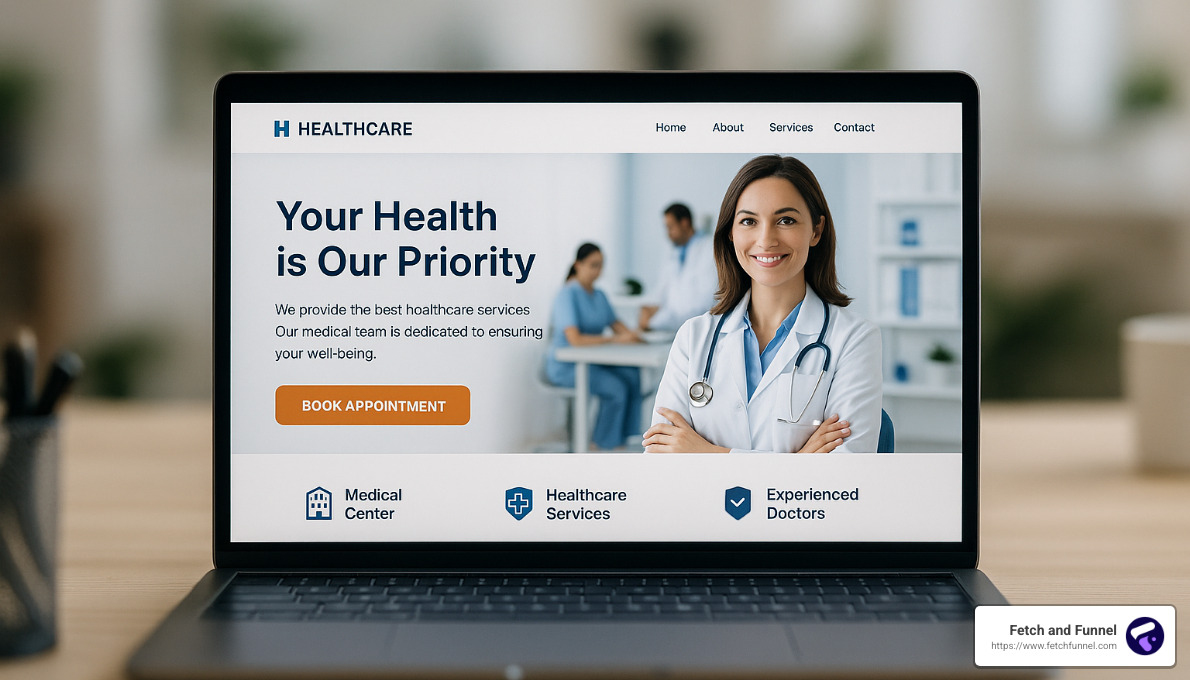
When it comes to conversion rate optimization for healthcare, landing pages truly are your digital workhorses. They’re where the magic happens—or doesn’t. The good news? Medical services landing pages average an impressive 7.4% conversion rate (with a median of 3.8%), making healthcare one of the highest-converting industries online.
But here’s the thing—these numbers only materialize when your landing pages are thoughtfully crafted with patients in mind. I’ve seen countless healthcare websites with beautiful designs that simply don’t convert visitors into patients.
What makes the difference? It starts with a clear value proposition. Your landing page should immediately answer why someone should choose your practice over competitors. One physical therapy client we worked with at Fetch and Funnel saw their conversion rate jump by 203% after we redesigned their homepage to emphasize “whole-patient care” rather than just listing services.
Healthcare consumers are typically in research mode, often scanning content rather than reading every word. Make your content scannable with short paragraphs, descriptive subheadings, and strategic bolding of key information. Think about how you read content when you’re looking for health information—you’re likely looking for specific answers, not settling in for a novel.
Your primary call-to-action should be visible without scrolling. This “above-the-fold” placement ensures visitors immediately see how to take the next step. As JR Justesen wisely noted, “It’s a much more patient-centric approach. I think it does a better job of building trust and making it easy for people to become patients.”
The way you arrange content matters too. Using an F-pattern design aligns with how people naturally read web content, guiding their eyes toward important conversion elements. When paired with mobile optimization (absolutely crucial now that online appointment booking has jumped from just 2.4% in 2015 to 32% in 2020), you create a seamless experience across all devices.
Don’t underestimate the power of educational content. Before asking someone to book an appointment, provide value through symptom information, condition explanations, or treatment overviews. This builds credibility and trust—essential currencies in healthcare marketing.
One of our most successful tactics at Fetch and Funnel has been removing homepage carousels (those sliding image banners) and replacing them with a single, clear headline and prominent CTA button. This aligns with latest research on CRO uplift showing that simplicity converts better than visual complexity every time.
Want to dive deeper? Learn more about Conversion Rate Optimization in Digital Marketing
Landing Page Checklist for Conversion Rate Optimization for Healthcare
Creating high-converting healthcare landing pages isn’t rocket science, but it does require attention to detail. Here’s what needs to be on your radar:
Your headline clarity can make or break your conversion rate. Ditch the medical jargon and speak plainly about benefits, not technical capabilities. A headline like “Relief from Chronic Back Pain Without Surgery” speaks directly to what patients actually want, rather than “Utilizing Advanced Spinal Manipulation Techniques.”
Develop service-specific pages for each treatment you offer. I’ve seen conversion rates double when practices create dedicated pages instead of lumping everything together. Include testimonials from actual patients who’ve received that specific treatment, address common questions, and highlight the specialists who perform the procedure.
Educational assets serve double duty—they both inform patients and position you as an authority. Downloadable guides, infographics explaining conditions, and short videos featuring your practitioners all build trust while educating. One orthopedic practice we worked with saw a 47% increase in leads after adding procedure walkthrough videos to their landing pages.
Don’t forget about location pages if you have multiple offices. Create geo-targeted landing pages for each practice location with maps, directions, parking information, and location-specific reviews. This local focus dramatically improves conversion rates for patients searching for care near them.
As one healthcare marketing expert put it: “If, after arriving at your website, patients are finding it difficult to book an appointment, you may lose them on the appointment page.” This perfectly captures why every element of your landing page should create a frictionless path to conversion.
Your landing pages aren’t just information repositories—they’re active participants in the patient acquisition process. When designed with conversion in mind, they become your most effective digital salespeople, working 24/7 to grow your practice.
Streamlined Forms & Persuasive CTAs
When it comes to conversion rate optimization for healthcare, nothing creates more immediate impact than thoughtfully designed forms. The data speaks volumes here – simply reducing form fields from 11 to just 4 can boost conversion rates by an impressive 120%. That’s the difference between struggling to fill your appointment calendar and having a healthy patient pipeline.

Let’s look at what actually happens when we optimize healthcare forms:
| Form Element | Traditional Approach | Optimized Approach | Impact on Conversion |
|---|---|---|---|
| Number of fields | 11+ fields | 4-5 essential fields | +120% conversion rate |
| Phone field | Required | Optional | +5% conversion rate |
| Field order | Random order | Logical progression | +30% completion rate |
| Form length | Single long form | Progressive disclosure | +55% initial engagement |
| Error handling | Generic messages | Specific guidance | -40% abandonment rate |
| Security indicators | None | HIPAA compliance badges | +25% trust signals |
Progressive disclosure is particularly powerful in healthcare – it’s the digital equivalent of a thoughtful conversation. Rather than bombarding potential patients with questions upfront, you collect just the essential information first, then gather more details after establishing that initial relationship. This approach respects privacy concerns while still ensuring you get the information you need.
I’ve seen this with our healthcare clients. One interesting insight? Making phone number fields optional instead of required can improve form completions by about 5%. While we all want that phone number for follow-up, sometimes it’s better to get most of the information than none at all because a patient felt uncomfortable sharing their number immediately.
Your call-to-action buttons deserve just as much attention as your forms. Think of CTAs as digital handshakes – they need to feel right to inspire confidence. Contrasting colors make buttons stand out from your site’s design, creating visual priority. One of our healthcare clients saw a remarkable 37.5% increase in leads simply by changing their button color from red to green – a small change with big results.
Sticky CTAs that follow patients as they scroll through your content serve as gentle reminders that help is just a click away. This is especially important on mobile devices, where content can feel endless and your booking button might otherwise disappear from view.
Words matter too. Instead of generic “Submit” buttons (which nobody finds inspiring), use action-oriented text like “Schedule Your Appointment” or “Get Expert Care Now.” These phrases connect directly to what patients actually want – solutions to their health concerns.
And remember – every extra click between interest and action creates another opportunity for doubt. Streamlining this path is essential for conversion rate optimization for healthcare success.
Learn more about Conversion Rate Optimization Testing
Crafting HIPAA-Compliant CTAs: Conversion Rate Optimization for Healthcare
Healthcare CTAs walk a unique tightrope – they need to motivate action while maintaining the trust and professionalism patients expect. Here’s how to strike that balance:
Single Action Focus is essential for reducing decision paralysis. Each page should have one clear primary action you want patients to take. We’ve found that when healthcare pages try to promote multiple services equally, conversion rates typically suffer. Secondary options should be visually distinct to maintain clear priorities. Testing different wording like “Book Appointment” versus “Schedule Consultation” can reveal surprising preferences among your specific patient population.
Privacy Language creates the reassurance patients need. Small notes near form fields that say “We respect your privacy” or clearly explain how information will be used can dramatically increase form completions. This isn’t just good practice – it builds the foundation of trust that healthcare relationships require.
Secure Icons serve as visual trust signals. HIPAA compliance badges and lock icons near forms aren’t just decorative – they actively demonstrate your commitment to patient privacy. One client saw a 15% increase in form submissions after adding security indicators to their appointment request page.
Mobile Tap Targets need special attention in healthcare. Many patients, especially older ones, may have dexterity challenges that make tiny buttons frustrating. Ensure all clickable elements are at least 44×44 pixels with adequate spacing. This seemingly small detail can make the difference between a completed appointment request and an abandoned one.
At Fetch and Funnel, we’ve consistently found that traditional marketing CTAs like “Buy Now” or “Act Fast” feel jarringly inappropriate in healthcare contexts. Instead, service-oriented language like “Get Your Personalized Care Plan” or “Download Treatment Recommendations” performs significantly better while maintaining the professional tone patients expect and deserve.
Trust & Credibility Signals That Convert

When it comes to healthcare marketing, trust isn’t just a nice-to-have—it’s the foundation of patient relationships. Did you know that 94% of patients read online reviews before choosing a provider? That’s why credibility signals are among your most powerful tools for conversion rate optimization for healthcare.
Think about it from the patient’s perspective: they’re making decisions about their health and wellbeing. They need reassurance that they’re in good hands. This is where strategically placed trust elements make all the difference.
Certifications & Credentials speak volumes about your expertise. When patients see your medical board certifications, hospital affiliations, and professional memberships prominently displayed, they instantly feel more confident in your abilities. These aren’t just logos—they’re visual shorthand for “you can trust us with your health.”
Personal connections matter tremendously in healthcare. Patient Testimonials create emotional bridges between potential patients and your practice. Video testimonials are particularly powerful, showing real people sharing their positive experiences. As one of our clients finded, adding condition-specific success stories to their service pages increased conversions by 36%.
“Healthcare is a trust-based business, so having images of smiling clinicians helps visitors connect with our team,” explains Isaac Justesen. This human element is why comprehensive Doctor Bios & Expertise sections are conversion gold mines. When patients can see your education background, special interests, and personal care philosophy, they begin to feel a connection before even walking through your door.
The social proof offered by Reviews & Ratings can’t be overstated. Interestingly, our data shows that practices displaying a mix of positive and negative reviews (with thoughtful responses to the negative ones) actually earn higher trust scores than those showing only glowing reviews. Authenticity resonates with healthcare consumers.
In an era of increasing privacy concerns, Privacy & Security Badges reassure visitors that their sensitive information is safe with you. HIPAA compliance indicators, secure payment icons, and data protection statements might seem like small details, but they significantly reduce anxiety around sharing personal information online.
Learn more about ethical marketing in healthcare and Conversion Optimization
Building Digital Trust Fast
You have mere seconds to establish credibility when someone lands on your website. How do you make the most of this narrow window? By strategically implementing trust-building elements that work quickly.
Transparent Pricing alleviates one of the biggest anxieties in healthcare decision-making. When patients can clearly see cost information, insurance acceptance details, and payment options, they’re more likely to move forward. One dental practice we worked with saw a 28% increase in appointment bookings after adding a simple pricing table to their most popular service pages.
Nothing builds trust faster than seeing real faces. Staff Photos & Personalities humanize your practice and create instant connections. As Hiram Cruz, Creative Director at a healthcare marketing agency, puts it: “Consistent design is important. We aren’t just building pages; we’re building a brand, and a shopping experience for that brand that is custom to that channel.” Show your team interacting naturally with patients (with proper consent, of course), and you’ll see engagement metrics climb.
External validation through Community Awards & Recognition provides powerful social proof. “Top Doctor” awards, community service initiatives, and press mentions all signal to potential patients that you’re respected by peers and valued by the community. These recognitions deserve prominent placement on your site.
Where you place trust elements matters tremendously. Strategic Social Proof Placement near conversion points can provide the final nudge a hesitant visitor needs. Mini-reviews next to CTAs, outcome statistics where relevant, and testimonials strategically positioned in the booking funnel can dramatically improve conversion rates.
At Fetch and Funnel, we’ve finded that changing real patient feedback into anonymized case studies significantly improves both credibility and conversion rates. When patients can see specific examples of how you’ve helped others with similar conditions, they’re much more likely to take that crucial next step toward becoming your patient.
Data-Driven Testing & Analytics for Conversion Rate Optimization for Healthcare

Without data, trying to optimize your healthcare website is like diagnosing a patient without running tests—you’re just guessing. At Fetch and Funnel, we approach conversion rate optimization for healthcare much like clinical research: methodically, with evidence-based decisions driving every change.
Think of A/B testing as your diagnostic tool. By comparing two webpage versions, you find what truly resonates with potential patients. We’ve seen remarkable differences when testing elements like headline language (clinical terminology versus patient-friendly benefits), button colors, and form designs.
I remember working with a dental practice that was skeptical about testing something “as simple as button text.” They were surprised when changing their CTA from “Schedule Now” to “Book Today” produced a 37.5% jump in conversions—generating 55 leads instead of 40 from the same 1,500 visitors. These small changes add up to significant patient acquisition improvements.
When your healthcare site has substantial traffic, multivariate testing becomes incredibly valuable. Rather than changing just one element at a time, you can examine how multiple variables interact together. As Catherine Tansey wisely puts it: “The benefit of multivariate tests is that they tend to yield more telling data.” Just remember, you’ll need larger sample sizes to reach statistical confidence.
Heatmaps offer fascinating insights into how real people interact with your healthcare website. They reveal the digital “body language” of your visitors—where they click, how far they scroll, and where they might get confused. We’ve used these visual tools to find that many patients were scrolling right past important insurance information or missing doctor credentials that would have built trust.
Mobile optimization cannot be overlooked. With research showing mobile pages load a whopping 70.9% slower than desktop versions on average, and knowing that healthcare searches increasingly happen on smartphones, speed matters tremendously. Compressing images while maintaining clarity, minimizing code bloat, and implementing lazy loading can dramatically improve the patient experience.
Accessibility isn’t just a compliance issue—it’s a conversion opportunity. When your website welcomes everyone, including those with disabilities, you’re expanding your potential patient base. Good contrast for visually impaired visitors, proper image alt text, and keyboard navigation aren’t just ethical best practices; they’re good business.
Learn more about Statistical Significance in Testing and Conversion Rate Optimization Tools
Iteration Framework
The magic of conversion rate optimization for healthcare happens when you follow a structured, repeatable process. At Fetch and Funnel, our framework keeps improvements flowing consistently:
Every test begins with a clear hypothesis. Rather than saying “let’s try a different button,” we frame it precisely: “Adding doctor credentials next to the booking CTA will increase conversions by making patients feel more confident in their choice.” These specific predictions, based on analytics and healthcare trends, guide our testing priorities.
Sample size matters tremendously in healthcare testing. With typical conversion rates between 3-7.4%, you need sufficient traffic to reach valid conclusions. We’ve had clients eager to call a test after just a few days, but patience pays off—allowing for natural variations in healthcare searching behavior between weekdays and weekends.
We aim for 95% confidence in our results, a standard that would make any medical researcher proud. But we also consider practical significance—sometimes a 5% lift might not justify a major redesign, while other times a small statistical improvement could represent dozens of new patients monthly.
The most successful healthcare organizations we work with accept CRO as an ongoing journey rather than a destination. Each test, whether it succeeds or fails, informs the next hypothesis in a continuous cycle of improvement. As Francis Bonilla notes, our team “takes pride in our thorough knowledge of the guidelines, and stays up-to-date on the newest modules, tiles, trends, releases, restrictions, and more.”
We’ve found special value in segmenting results by device type. Mobile and desktop users often have different needs and behaviors—a booking form that works perfectly on desktop might frustrate smartphone users with small tap targets or excessive typing requirements.
This iterative approach creates compounding improvements over time. Just as compound interest grows your savings exponentially, consistent testing grows your patient acquisition capabilities far beyond what one-time website updates could achieve.

Conclusion

Conversion rate optimization for healthcare represents one of the most significant opportunities for medical practices to improve patient acquisition without increasing marketing spend. As we’ve explored throughout this guide, healthcare organizations face unique challenges in the digital space—balancing compelling marketing with strict privacy regulations while building the trust necessary for patients to take action.
Let’s recap the key strategies for boosting patient engagement through CRO:
Develop patient-centric landing pages that clearly communicate your value proposition and make it easy for visitors to take the next step.
Streamline forms and create compelling CTAs to reduce friction in the appointment booking process, remembering that reducing form fields from 11 to 4 can improve conversions by up to 120%.
Build trust through strategic credibility signals including certifications, testimonials, and transparent information about your providers and practice.
Implement a data-driven testing framework to continuously improve your website based on real patient behavior and preferences.
Ensure mobile optimization to capture the growing segment of patients who book appointments on smartphones and tablets.
The healthcare landscape continues to evolve, with patients increasingly adopting consumer behaviors in their healthcare decisions. As online appointment booking has increased from 2.4% in 2015 to 32% in 2020, the importance of an optimized digital patient journey has never been greater.
At Fetch and Funnel, our Boston-based team specializes in helping healthcare organizations transform their digital presence into a powerful patient acquisition engine. Our approach combines creative strategy with data-driven optimization to improve the patient experience while driving measurable results.
Whether you’re looking to improve your current website’s performance or build a new digital experience from the ground up, effective conversion rate optimization for healthcare requires a partner who understands both the technical aspects of CRO and the unique needs of healthcare organizations.
Ready to take the next step in optimizing your healthcare website for conversions? Learn more about our CRO agency services or contact us to discuss how we can help your practice achieve exceptional results.
In healthcare marketing, every conversion isn’t just a number—it’s a patient who needs your care. By optimizing your digital experience, you’re not just improving your metrics; you’re making it easier for patients to access the healthcare services they need.


