Why Understanding Lead Costs is Crucial for Your ROI
Cost per lead real estate is the metric that determines if your marketing budget is building your business or burning cash. In 2025, lead costs range from as low as $5 for organic content to over $350 in competitive markets like New York City and San Francisco. Understanding these numbers is essential for survival.
Here’s what you need to know about Cost per lead real estate:
- Average CPL ranges from $20–$100 across all channels, but varies by platform and location.
- Buyer leads typically cost $9–$20, while seller leads run $26–$60+.
- Google Ads average $50–$150 per lead with high intent.
- Facebook/Instagram deliver $20–$80 per lead with lower intent.
- Content marketing starts at $80–$100 per lead but drops to $5–$20 over time.
- Location matters: NYC/SF can hit $200–$350+ while smaller markets stay at $10–$30.
The challenge isn’t just knowing what leads cost—it’s knowing which are worth the investment. A $10 lead that never converts is more expensive than a $100 lead that closes. The key is measuring Cost Per Close (CPC) alongside CPL to understand your true ROI.
I’m Samir ElKamouny, founder of Fetch and Funnel. We help real estate professionals optimize their lead spend and turn it into a profit engine. After managing millions in ad spend, I’ve learned that winning agents don’t just find the cheapest leads—they understand the complete picture of costs, conversion rates, and long-term value.
Decoding the Numbers: 2025 Benchmarks for Cost Per Lead Real Estate
When we talk about the Cost per lead real estate, we’re diving into the financial heartbeat of your marketing. In 2025, average CPLs range from $20 to $100, but this is just a starting point. The true cost varies based on platform, lead quality, and intent. At Fetch and Funnel, we help you make data-driven decisions to ensure every dollar works for your business.
Understanding these benchmarks is crucial. A lead from social media may seem cheaper, but a Google lead often has higher intent. Someone searching “homes for sale in Boston” is actively looking, which dramatically impacts conversion rates and ROI. The goal isn’t the lowest CPL, but the most effective Cost per lead real estate.
Paid vs. Organic Lead Costs: A Tale of Two Strategies
Your lead generation strategy has two main approaches: paid and organic.
Paid ads are like sprinters, delivering immediate results. Platforms like Google Ads and Meta Ads (Facebook/Instagram) can generate a steady stream of leads quickly, but this speed comes at a price. Paid ads generally have a higher Cost per lead real estate. For example, Google Ads averages around $53.52 CPL for standard campaigns. While effective for short-term growth, the leads stop when your budget runs out.
Organic SEO and content marketing are your marathon runners, building a sustainable, compounding asset. This means creating valuable content like blog posts or local market guides that naturally attract clients over time. Once established, the CPL for organic leads drops significantly. Initially, content marketing CPLs might be around $80-$100, but they can fall to $7-$30 once your content gains authority. As experts remind us, building a pipeline of leads takes time, but the long-term ROI is often superior. In competitive areas like Boston, a robust organic strategy provides a crucial competitive edge.
Platform Cost Breakdown: Where Your Money Goes
Let’s explore the specifics of where your marketing dollars go and what kind of Cost per lead real estate you can expect from different platforms. Here’s a quick overview:
| Platform | Average CPL (USD) | Lead Intent | Typical Conversion Rate |
|---|---|---|---|
| Google Ads (Search) | $50 – $150 | High | 4% – 8% |
| Meta Ads (Facebook/Instagram) | $20 – $80 | Medium/Low | 1% – 3% |
| Real Estate Portals (Zillow/Realtor.com) | $30 – $120 | Medium/High | 2% – 7% |
| Organic Lead Generation (SEO, Content) | $5 – $20 | High | 2% – 5% |
-
Google Ads: This platform is a premium lead source because it captures prospects actively searching for real estate services. Someone typing “homes for sale in Boston” has high intent, justifying the higher CPL of $50-$150. Because conversion rates can be 3-5 times higher than social media, the ROI is often excellent. For example, CINC’s Google Buyer portfolio for the Boston-Cambridge-Newton area has shown fluctuating CPLs year-over-year.
-
Meta Ads (Facebook/Instagram): Social media platforms deliver affordable leads, with 2025 Meta Ads averaging $20-$80. The trade-off is lower lead intent, as people are often browsing for entertainment, not actively searching for a home. These leads require more nurturing and a longer sales cycle. However, with Fetch and Funnel’s sophisticated targeting, we can still reach highly relevant audiences in the Boston area.
-
Real Estate Portals (Zillow, Realtor.com): These platforms act as digital marketplaces. Zillow leads typically cost $20-$60, but the average in major metro areas can be $223 versus $139 outside those zones. Realtor.com often uses a set monthly fee rather than a CPL model. Our research shows Zillow leads can be further along in the process, but some agents report a decline in quality and an increase in “fake leads.”
Buyer vs. Seller Leads: Understanding the Cost Difference
The type of lead you’re trying to acquire significantly impacts your Cost per lead real estate.
Generally, buyer leads are less expensive, often ranging from $9-$20 per lead. This is because there’s a larger pool of potential buyers who are easier to attract with broader marketing. For instance, Sierra Interactive’s Google Buyer campaigns in the US in early 2023 saw average CPLs of US$9–$13.
Seller leads are more challenging and expensive, often costing $26-$60 or more. Sellers are a smaller, more discerning group, and fierce competition for listings drives up the cost. Sierra Interactive’s Seller campaigns in early 2023 saw CPLs of US$26-$30. In competitive markets like Boston, we’ve seen seller lead costs from Google Ads range from $14.67 (Q3 2023) to $21.61 (Q1 2024). The higher value of a seller lead—a potential listing commission—often justifies this increased acquisition cost.
Key Factors That Drive Your Real Estate Lead Costs
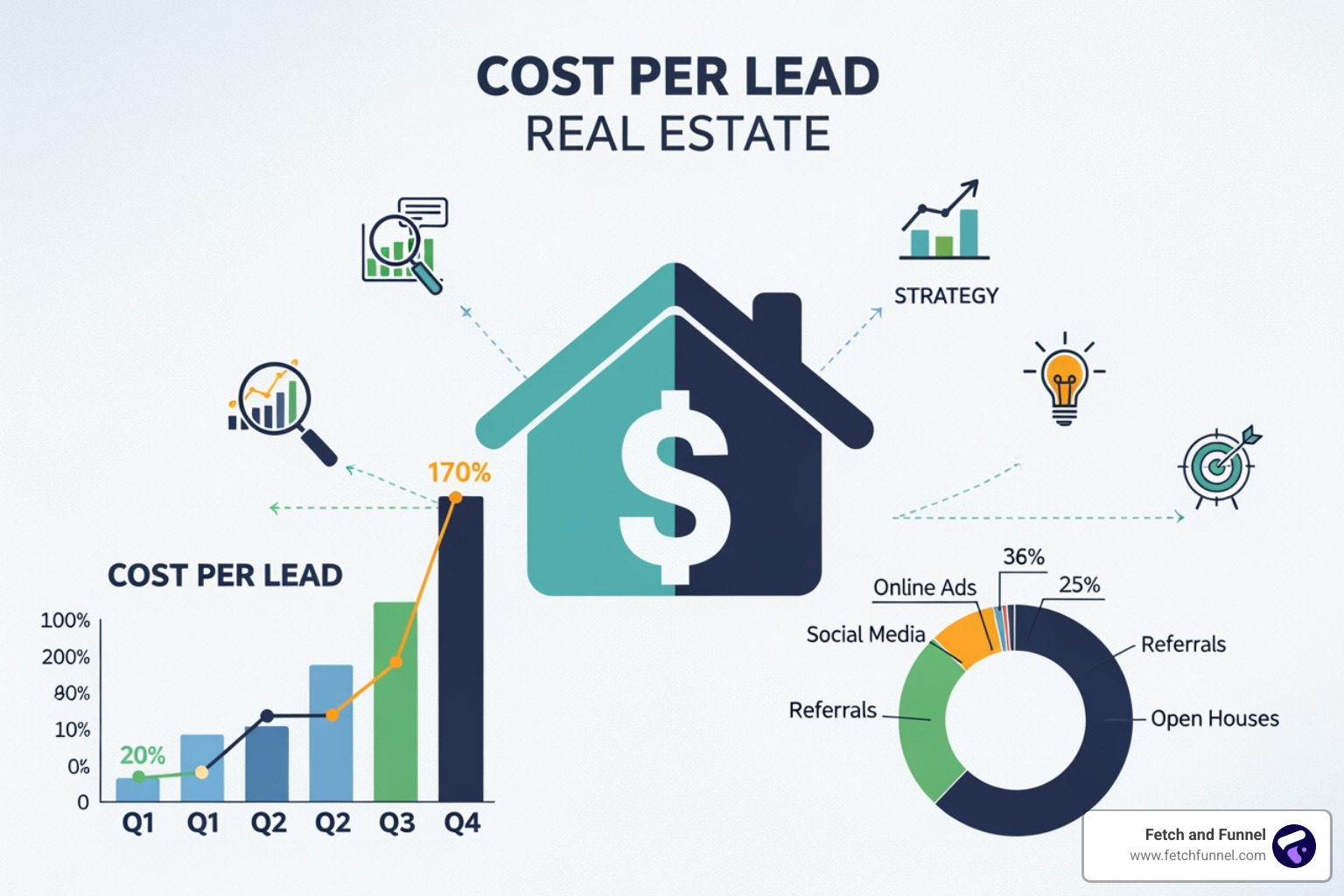
You’ve seen the benchmarks, but your Cost per lead real estate might look completely different from national averages. Several powerful variables work behind the scenes to either inflate or deflate your costs. Understanding these factors is what separates agents who control their budget from those who wonder where their money went.
At Fetch and Funnel, we’ve managed campaigns across dozens of markets. Two agents running identical campaigns can see wildly different results based on just a handful of influencing variables. Let’s break down what’s really driving your lead costs.
Market Competition and Location
Geographic location is crucial for your marketing costs. Highly competitive markets command premium prices for leads. In hot spots like New York City, San Francisco, and Boston, average Cost per lead real estate can easily hit $200-$350, and in extreme cases, $416-$480. You’re not just competing with the agent down the street—you’re in bidding wars with hundreds of professionals for the same limited pool of clients.
When local market saturation is high, advertising platforms like Google and Facebook operate on auction-based systems. More agents bidding on the same keywords and audiences means higher costs. In Boston, for example, we see intense competition for terms like “homes for sale in Back Bay,” which drives up costs significantly.
Conversely, agents in rural or less developed areas might enjoy CPLs as low as $10-$30 due to lower competition. Understanding this geographic impact helps put your costs in perspective.
Lead Quality and Intent
A $20 lead isn’t always cheaper than a $200 lead. The quality and intent determine its true value.
Low-quality leads ($20-$30) are often cold contacts who require extensive nurturing. Medium-quality leads ($40-$60) have shown some interest but are still in the early stages. High-quality leads ($100-$200+) come with genuine intent—they are actively searching for real estate services and have much higher conversion potential.
A Reddit user captured this perfectly when discussing Zillow leads: “Zillow leads seem to be much further along in the process and ready to buy than PPC lead sources, which are much cheaper. But that’s why they’re so expensive.” This observation highlights the trade-off between cost and quality. Paying more upfront can mean a faster path to commission.
The lead source also plays a massive role. Leads from search engines typically have higher intent than leads from social media browsing.
Beyond CPL: Calculating the True ROI of Your Cost Per Lead Real Estate Spend
If you’re only looking at Cost per lead real estate, you’re missing the bigger picture. I’ve seen agents celebrate $10 leads that never convert while complaining about $100 leads that consistently close.
The metrics that actually matter are Cost Per Close (CPC) and Cost Per Acquisition (CPA). These numbers, which platforms like BoomTown help agents track, tell you the total marketing and sales expenses required to acquire an actual client who signs a contract and closes a deal. While CPL measures the cost of getting someone’s contact information, CPC measures the cost of getting a paycheck.
Here’s how the math works. Imagine Campaign A delivers leads at $20 each, but only 1% convert. Your true Cost Per Close is $2,000. Campaign B delivers leads at $50 each, but 10% convert. Your Cost Per Close is just $500. Which campaign is actually cheaper?
Your conversion rate is the multiplier that determines whether your lead costs make sense. A higher conversion rate means a lower Cost Per Close, even if your initial CPL is higher. This is why we always emphasize quality over quantity. Five high-intent leads that convert at 20% are worth infinitely more than 100 low-quality leads that convert at 0.5%.
To calculate your true ROI, you need to track three things: your CPL for each channel, the conversion rate from lead to close for each channel, and your average commission per sale. Only then can you see which channels are actually building your business.
Actionable Strategies to Lower Your CPL and Boost Lead Quality

Understanding your Cost per lead real estate is only valuable if you can act on it. Fortunately, proven strategies can slash your costs while improving lead quality. At Fetch and Funnel, we’ve seen these tactics transform campaigns, especially in competitive markets.
The secret isn’t a magic bullet; it’s about being smarter with your channels and building assets that compound over time. This involves optimizing what’s working now while planting seeds for future growth.
Refining Your Paid Advertising Campaigns
If your paid ads feel like a black hole for money, small adjustments can make a massive difference. Start with hyper-local targeting. Instead of a wide net across Boston, zoom in on specific neighborhoods like Guide Hill or Jamaica Plain. Geofencing lets you target people in specific locations, like competing open houses.
A/B testing different ad creative—images, headlines, and calls-to-action—is how you find what resonates with your audience. Video content, for example, consistently outperforms static images. Also, ensure your landing page optimization is on point with fast load times and simple forms to capture intent.
Retargeting lets you stay in front of warm leads who have already shown interest, often converting at 40-60% lower costs. Similarly, custom audiences built from your existing client lists help you find new prospects who look just like your best customers.
Investing in Long-Term ROI with Content and SEO
While paid ads are your sprint, content and SEO are your marathon. This is where patience pays off with dramatically lower Cost per lead real estate over time.
Content marketing for real estate means becoming the trusted expert in your market. Create local market reports that dive deep into what’s happening in specific Boston neighborhoods. Publish neighborhood guides that help buyers understand what life is really like in different areas—the schools, the coffee shops, the commute times, the community vibe.
Write about what your clients actually ask you. First-time buyers want to know about down payment assistance programs in Massachusetts. Sellers want to know how to prepare their home for maximum value. When you answer these questions with genuinely helpful content, you’re not just generating leads—you’re building trust.
SEO for real estate, a service offered by many specialized firms like Luxury Presence, ensures this content actually gets found. When someone searches for “Back Bay condo market trends” or “best family neighborhoods in Boston,” your content should appear. This organic traffic comes from people actively seeking information, which means higher intent and better conversion rates.
The beautiful thing about content is that it’s a compounding asset. Yes, initially your CPL for content marketing might be around $80-$100 as you’re building. But once your content gains traction and your domain authority grows, that CPL can drop to $5-$20. You’re getting high-quality leads for less than the cost of lunch.
How to Budget for Lead Generation Based on Your Cost Per Lead Real Estate Goals
Let’s talk numbers. How much should you actually spend on lead generation? The industry standard suggests allocating at least 10% of your total income to your marketing strategy, with established brokerages sometimes pushing this to 15-20%. This isn’t an expense—it’s an investment in your business growth.
Here’s a simple way to think about budgeting. Start by setting your lead goals. If you want to close 10 transactions this year and your typical lead-to-sale conversion rate is 5%, you need 200 leads. Now calculate your required marketing spend by multiplying those 200 leads by your average CPL. If you’re paying $50 per lead, that’s a $10,000 annual budget.
For new agents, we recommend a hybrid approach that weights your budget toward paid ads initially—think 70-80% paid, 20-30% content. Why? Because you need leads now to pay the bills, but you also need to start building those long-term assets. As your content begins generating organic leads and your business stabilizes, you can gradually shift toward a more balanced split or even favor organic channels more heavily.
The key is sustainability. Your lead generation budget needs to be something you can maintain for at least 12 months to see consistent results. Quick bursts of spending followed by dry periods don’t build momentum—they just create a feast-or-famine cycle that’s stressful and inefficient.
Frequently Asked Questions about Real Estate Lead Costs
You’ve got questions about Cost per lead real estate—we’ve got answers. These are the most common concerns we hear from real estate professionals trying to make sense of their marketing spend.
What is a good cost per lead for real estate in 2025?
A “good” CPL isn’t a fixed number—it’s what’s profitable for your business. Generally, expect a range of $20–$100. For competitive buyer leads, a good CPL is around $15–$35, while seller leads run $25–$60 or higher. The key insight is that the best CPL is one that yields a profitable Cost Per Close. A $50 lead that converts at 10% is far better than a $10 lead that converts at 1%. Always calculate backwards from your commission to determine what you can afford to pay.
Why are search ads more expensive than social media ads for real estate leads?
It all comes down to intent. When someone types “real estate agent near me” into Google, they are actively searching for services right now. This high intent creates fierce competition among advertisers, driving up costs. You’re paying more for leads that are significantly warmer and closer to a decision.
Social media ads, on the other hand, target users who are passively browsing. They aren’t actively house hunting at that moment, which means lower initial intent and longer conversion times. The trade-off is a lower price point. These leads need more nurturing but can become clients with the right follow-up. They are different tools for different stages of the buyer’s journey.
Should new agents focus on low-cost leads or high-quality leads?
If you’re a new agent, you’re probably feeling the pressure to get deals closed yesterday. We get it. The answer isn’t either/or—it’s both, strategically.
A balanced approach is your best bet. Low-cost leads from social media platforms can help you build a robust pipeline and practice your follow-up skills without breaking the bank. These leads give you volume, which is important when you’re learning what messaging resonates and refining your sales process.
However, you also need cash flow now. That’s where investing in a smaller number of high-quality, high-intent leads from search ads, a specialty of platforms like Ylopo, becomes crucial. Yes, they’re more expensive upfront, but they can provide quicker wins and essential early revenue that keeps your business afloat while your longer-term strategies mature.
Think of it as a 70/30 split initially—70% of your budget on paid channels that deliver immediate results, and 30% on building content and organic presence. This gives you the leads you need today while setting up your tomorrow. As you close more deals and build your reputation, you can shift that balance and rely more heavily on organic channels that deliver better long-term ROI.
Conclusion: Making Your Marketing Dollars Work Smarter
We’ve covered how Cost per lead real estate varies across platforms and lead types, and the key factors that influence your budget. The main takeaway is that chasing the cheapest lead isn’t a smart strategy. Your true north should always be your return on investment (ROI).
By understanding how your CPL affects your Cost Per Close, you can make data-backed choices. This isn’t about spending less, but spending smarter. A balanced, hybrid strategy often works best, blending the quick wins from paid advertising with the long-term power of content marketing and SEO to build a sustainable lead pipeline.
Here at Fetch and Funnel, we love helping real estate pros, especially in busy markets like our own Boston. We guide you with creative ideas and data-driven tweaks to improve customer experiences and boost your ROI, turning your marketing spend into your biggest asset.
Ready to stop guessing and start growing? Let us help you optimize your lead generation. Learn more about our Facebook Ads for Real Estate services or explore our other solutions designed to transform your real estate marketing.