

Why Your Ads Need to Follow Your Customers
Cross channel retargeting is a marketing strategy that tracks and targets customers across multiple platforms and devices, creating a unified experience that significantly boosts conversion rates and ROI.
Quick Implementation Guide:
- Set up unified tracking across all platforms (Meta Pixel, Google Ads tag, etc.)
- Centralize customer data from all touchpoints
- Create connected campaigns that share audience data
- Segment audiences based on cross-channel behavior
- Maintain consistent messaging while adapting creative for each platform
According to Google, 90% of people switch between devices to complete a task. This fragmented customer journey is a massive challenge for brands.
Your customer might find your product on Instagram, research it on their desktop, and purchase on their tablet. Traditional marketing treats these as separate interactions, losing the thread. Cross channel retargeting connects these platforms, sharing data to create a seamless experience that follows customers wherever they go, capturing otherwise lost sales.
The results speak for themselves. Consumers are 250% more likely to purchase when retargeted across multiple channels, and 67% of users start a purchase on one device and finish it on another.
I’m Samir ElKamouny, founder of Fetch & Funnel, where I’ve helped scale countless e-commerce brands using advanced cross channel retargeting strategies. I’ve seen how brands that master cross-channel integration dramatically outperform those stuck in single-platform thinking.
Understanding Cross-Channel Retargeting vs. Multi-Channel
Retargeting is designed to re-engage people who visited your website but didn’t convert—a digital tap on the shoulder saying, “Hey, remember us?” If you want to dive deeper, check out our guide on What is Retargeting in Marketing?.
While they sound similar, multi-channel and cross-channel retargeting are very different.
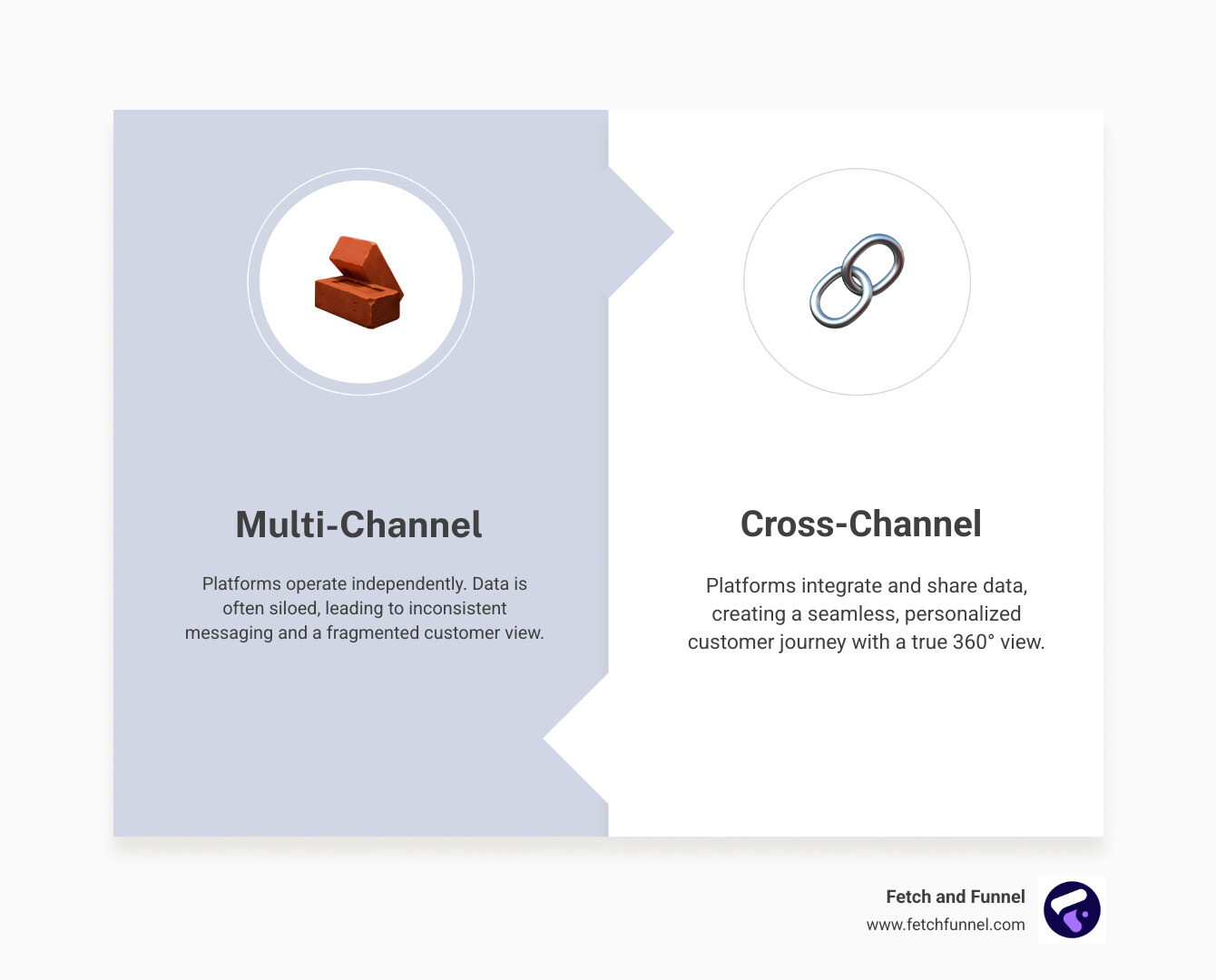
Multi-channel retargeting reaches customers on different platforms—Facebook, Google, email—but each channel operates in a silo. Your Facebook ads don’t know what your Google ads are doing, creating a disjointed experience.
Cross channel retargeting connects all your platforms so they work together as a coordinated team. Your Facebook ads know when someone clicked a Google ad, and your email campaigns understand their journey, creating one seamless experience.
This integration is crucial because customers switch devices constantly. Without it, you miss key touchpoints in their journey.
| Feature | Multi-Channel Retargeting | Cross-Channel Retargeting |
|---|---|---|
| Data Integration | Limited; channels operate independently | High; data shared and unified across channels |
| Customer Experience | Disjointed; messages may not be coordinated | Seamless; consistent and personalized journey |
| Measurement | Complex, often siloed | Unified tracking with multi-touch attribution |
The Power of a Unified Customer View
Customer data is often scattered across your email platform, CRM, and ad platforms. Without bringing this data together, you’re marketing to puzzle pieces instead of complete people.
Cross channel retargeting breaks down these data silos. By centralizing first-party data from all touchpoints—website visits, email opens, social media interactions, and even offline store visits—you create a 360-degree customer view.
This unified view allows for powerful personalization. Instead of generic ads, you can craft messages based on a customer’s complete journey. For example, if they browsed coats and opened related emails but abandoned their cart, you can create a highly targeted campaign that speaks directly to their behavior.
Integrating your CRM with ad platforms is key. It allows you to build trust through relevant, timely messaging instead of irrelevant ads. Learn more about this approach with our insights on customer journey retargeting.
Key Statistics That Prove Its Worth
The numbers behind cross channel retargeting are compelling. Consumers are 250% more likely to purchase when retargeted across multiple channels versus just one.
Furthermore, cross-device retargeting can deliver a 120% increase in ROI, a 38% boost in average order value, and a 30% reduction in cost per acquisition. These metrics directly impact your bottom line.
This is driven by modern shopping habits: 67% of users start a purchase on one device and finish on another. Your marketing needs to meet them there.
Compared to single-channel approaches, cross channel retargeting campaigns also show a 19% increase in conversion rates and 22% more revenue. These statistics highlight why an integrated, cross-channel strategy is essential, not optional.
Building Your Cross-Channel Retargeting Strategy

Now, let’s get into the “how.” An effective cross channel retargeting strategy requires thoughtful planning. The key is to account for unique customer journeys—some research for weeks, others buy on impulse—while maintaining a consistent brand experience.
Step 1: Define Your Goals and Map the Customer Journey
Every successful campaign starts with clear objectives. For cross channel retargeting, this clarity is critical. Define your primary goal: are you trying to increase brand awareness, generate leads, drive conversions, or improve customer retention? Each goal requires a different approach.
Next, map your customer journey. With attention spans shorter than ever, customers bounce between touchpoints quickly. A customer might see a TikTok ad, visit your site on their phone, research reviews on a laptop, and buy on a tablet days later. Identifying every potential interaction—from social media findy to email subscriptions—helps you deliver the right message at the right moment.
Step 2: Choose Your Platforms and Channels
Selecting the right platforms is about aligning your choices with where your audience spends their time.
- Google Ads: Captures high-intent searchers. The Display Network and YouTube offer great visual storytelling opportunities.
- Meta Ads (Facebook & Instagram): Excellent for reaching people based on interests and behaviors. Ideal for visually engaging content. Learn more with our guide on Facebook Retargeting Strategies.
- LinkedIn Ads: Essential for B2B, allowing you to target decision-makers with precision. For more on this, HubSpot provides a useful guide.
- TikTok Ads: Highly effective for younger demographics, with an algorithm that excels at finding engaged audiences.
- Programmatic Display: Provides access to millions of websites and apps, perfect for maintaining brand awareness.
- Email Retargeting: Often the most cost-effective channel. An automated cart abandonment sequence can recover 10-15% of lost sales. Platforms like Klaviyo offer powerful tools for this.
Step 3: Segment Your Audiences for Maximum Impact
Generic ads kill conversions. Audience segmentation is essential for cross channel retargeting. Create hyper-specific segments based on behavior, not assumptions. For a different perspective, AdRoll offers best practices on the topic.
- Website Visitors: Your broadest segment. Refine it by differentiating between a brief homepage visit and someone who browsed multiple product pages.
- Cart Abandoners: High-value prospects who were ready to buy. A well-timed campaign can recover 20-30% of these potential customers.
- Product Viewers: If someone viewed your red running shoes, show them ads for those exact shoes, not your whole catalog. Specificity improves conversion rates.
- Past Purchasers: These customers already trust you. They are perfect for cross-selling, upselling, or loyalty incentives.
- High-Value Customers: Your VIPs. Offer them exclusive deals and early access to new products.
- Lookalike Audiences: Scale beyond your existing customer base by finding new prospects who share traits with your best customers. Explore our guide on Facebook Ads Audience Research for more.
- Time-Based Segmentation: A visitor from yesterday needs a different message than one from three weeks ago. Tailor your messaging based on recency.
Crafting and Optimizing Your Creative Assets

Once you’ve identified your audience and platforms, it’s time to create ads that convert. The secret is smart adaptation: maintain your brand identity while speaking each platform’s native language.
Ensuring Consistent Branding and Messaging
Your brand should be instantly recognizable. This means your brand voice and visual identity (logos, colors, fonts) must be consistent across all channels. When someone sees your ad on Facebook after visiting your website, it should trigger a moment of recognition.
Consistent doesn’t mean identical. Your core message—like “Get 20% off your first order”—should be adapted for each platform. On Instagram, it might be a vibrant story; on Google Display, a clean banner ad.
The goal is a seamless experience that builds familiarity and trust. When customers see consistent messaging across multiple touchpoints, it reinforces your value proposition. For inspiration, check out our examples of creative retargeting ads.
Best Practices for Platform-Specific Creatives
Each platform has its own personality, and your creatives need to respect it.
- Formats and Aspect Ratios: A square Instagram post won’t work as a horizontal banner. Create properly sized versions for each platform to maximize performance.
- Copy and CTAs: Character limits force clarity. Be concise and ensure your calls-to-action (“Shop Now,” “Learn More”) are direct and unambiguous.
- Video Content: Video is king, but a 30-second YouTube ad won’t work as a 6-second Instagram story. Create shorter, punchier versions for feeds and stories, grabbing attention in the first 3 seconds.
- Dynamic Ads: These are game-changers for e-commerce. They automatically pull from your product catalog to show users items they’ve already viewed. It’s personalization at scale. Many platforms, including competitors like Criteo, specialize in dynamic ads.
- A/B Testing and Ad Fatigue: Constantly test headlines, images, and CTAs. For more on testing methodologies, Optimizely provides a great introduction to A/B testing. Rotate your creatives regularly to avoid ad fatigue—no one wants to be stalked by the same ad for weeks.
Measuring Success and Overcoming Challenges

Launching cross channel retargeting campaigns is one thing; measuring what’s working and navigating roadblocks is the real challenge. Success depends on a measurement system that reveals what’s truly driving results.
How to Effectively Track and Measure Your Cross-Channel Retargeting ROI
Tracking your campaigns is like assembling a puzzle; you need all the pieces to see the full picture.
- Unified Tracking: Your foundation is implementing tracking pixels (Meta Pixel, Google Ads tag) across your site. These code snippets track user behavior and build your retargeting audiences.
- Google Tag Manager: This tool centralizes all your tracking codes, acting as a universal remote for your analytics.
- UTM Parameters & Multi-Touch Attribution: Relying on platform-specific reporting is a mistake, as each platform takes credit for the same conversion. UTM parameters tell Google Analytics where traffic came from, while multi-touch attribution shows how channels work together. For a detailed breakdown, HubSpot offers an excellent guide to marketing attribution.
Here’s how different attribution models stack up:
| Attribution Model | Description | Best For |
|---|---|---|
| First-Touch | Credits the first interaction | Understanding awareness channels |
| Last-Touch | Credits the final interaction | Simple reporting, closing channels |
| Linear | Spreads credit equally across all touchpoints | Getting a balanced view |
| Time-Decay | Gives more credit to recent interactions | Short sales cycles |
| Position-Based | Credits first and last touch most | Balancing awareness and conversion |
The metrics that matter most are Return on Ad Spend (ROAS), Cost Per Acquisition (CPA), Conversion Rate (CVR), and Customer Lifetime Value (LTV). These numbers show which channels deserve more budget and which need optimization.
Common Challenges and How to Overcome Them
Every marketer faces these challenges. Knowing how to handle them is key.
- Attribution Complexity: When multiple channels contribute to a sale, who gets credit? Implementing multi-touch attribution models provides a clearer picture than the default last-click model.
- Budget Management: Continuously monitor performance and be willing to shift spend based on unified tracking data, not assumptions.
- Data Silos: Centralize customer data in a data warehouse or Customer Data Platform (CDP) to create a single source of truth. To understand CDPs better, you can explore resources from providers like Segment.
- Creative Fatigue: Regularly rotate creatives and use dynamic ads to keep content fresh and relevant.
- Ad Frequency Capping: Set limits on how often someone sees your ads, ideally managing frequency across all channels simultaneously.
- Privacy Regulations: Stay transparent about data collection, obtain proper consent, and focus on building your first-party data.
Frequently Asked Questions about Cross-Channel Retargeting
After helping hundreds of brands with cross channel retargeting at Fetch & Funnel, I’ve noticed the same questions come up. Here are the answers that have helped our clients get results.
What is the main difference between cross-channel and multi-channel retargeting?
Think of multi-channel as employees who don’t talk to each other. Each platform (Facebook, Google) runs its own campaigns in a silo. A customer might get a cart abandonment email and a “new customer” ad at the same time.
Cross channel retargeting is like a team in a daily meeting. Platforms share data and coordinate efforts. When a customer abandons a cart, all channels adjust their messaging accordingly. This creates a seamless, connected journey that is more efficient and effective.
How does a 360-degree customer view improve retargeting?
Retargeting without a complete customer view is like marketing with a blindfold on. A 360-degree view brings together data from all touchpoints—website activity, email opens, past purchases, and more.
Instead of seeing an anonymous visitor, you see a complete profile. This allows for hyper-personalized segmentation. You can create messaging that acknowledges their history with your brand and shows them products they’re genuinely interested in. It stops feeling like advertising and starts feeling like a helpful reminder.
What are the first steps to implementing a cross-channel retargeting campaign?
Starting your first campaign doesn’t have to be overwhelming. Begin with clarity, not complexity.
- Start with a single, clear goal. For example, reduce cart abandonment by 20%.
- Map your customer’s actual journey. Use analytics to see how people move through your site and where they drop off.
- Choose your platforms strategically. Pick the two or three channels where your audience spends the most time.
- Set up unified tracking. Install the Meta Pixel, Google Ads tag, and other necessary pixels. This step is crucial for building the audiences that make cross channel retargeting so powerful.
Start simple, test what works, and expand from there.
Conclusion: Unify Your Advertising for Maximum Impact
Managing advertising across multiple platforms without a unified strategy is inefficient. Cross channel retargeting represents a shift from the old “spray and pray” approach to a more sophisticated and effective method. By connecting our ad platforms, we create a seamless experience that helps customers and improves metrics.
The numbers don’t lie: consumers are 250% more likely to purchase when retargeted across multiple channels, and 67% of users complete purchases across different devices. These statistics reflect how people shop today.
This guide covered the essential building blocks: understanding the strategy, building a unified customer view, choosing platforms, segmenting audiences, and creating compelling, adaptable creative. Each piece works together to create something more powerful than the sum of its parts.
The key takeaway is that integration is everything. When your Google Ads, Meta campaigns, and email marketing work together, you create a customer experience that feels personal and relevant, not scattered.
A data-driven strategy makes this possible. By centralizing customer information, we can deliver the right message to the right person at the right moment. Looking ahead, the future of advertising is increasingly integrated and intelligent. Brands that adopt cross channel retargeting now will gain a significant advantage.
At Fetch & Funnel, we specialize in building these sophisticated, data-driven strategies to help brands scale profitably. By focusing on the complete customer journey, we turn ad clicks into loyal customers.
Ready to stop chasing your customers and start guiding them toward conversion? Find how to perfect your customer journey retargeting strategy and see how a unified approach can transform your advertising results.


