Why Full Funnel Demand Generation Matters for Modern B2B Growth
Full funnel demand generation is a strategic marketing approach that guides potential customers through every stage of their buying journey—from initial awareness to final purchase and beyond—by delivering the right content and experiences at each touchpoint to build trust, educate buyers, and create sustainable demand for your product or service.
Key Components of Full Funnel Demand Generation:
- Top of Funnel (TOFU): Create awareness through content marketing, SEO, and thought leadership to attract potential buyers
- Middle of Funnel (MOFU): Nurture consideration with case studies, webinars, and targeted content that builds trust
- Bottom of Funnel (BOFU): Convert demand into revenue through demos, consultations, and sales enablement
- Post-Funnel: Foster customer loyalty and advocacy to drive retention and referrals
The problem with traditional lead generation is simple: it doesn’t work anymore.
Most B2B companies are still chasing Marketing Qualified Leads (MQLs) with tactics like gated content, cold outreach, and aggressive sales pitches. But modern buyers have fundamentally changed how they research and make decisions. They complete up to 70% of their research before ever talking to sales. And here’s the uncomfortable truth: only 3% of your target market is ready to buy right now.
Traditional lead generation focuses exclusively on that tiny 3%—the people actively searching for a solution today. It ignores the other 97% who will buy eventually, just not yet. This creates three critical problems:
- High acquisition costs from competing for the same small pool of in-market buyers
- Low conversion rates because you’re pushing sales conversations on people who aren’t ready
- Commoditized positioning where you’re just “another vendor” without differentiation
Full funnel demand generation solves this by shifting focus from capturing existing demand to creating demand long before buyers are ready to purchase. Instead of interrupting people with cold calls that 90% of B2B decision makers ignore, you build relationships through valuable content, thought leadership, and strategic engagement across every stage of the buyer journey.
This guide breaks down exactly how to build a full funnel demand generation system that works—especially for B2B companies with long sales cycles and high Average Contract Value (ACV). You’ll learn the practical frameworks, proven strategies, and real metrics that drive sustainable pipeline growth.
I’m Samir ElKamouny, founder of Fetch and Funnel, where I’ve spent years helping brands scale revenue through performance-driven full funnel demand generation strategies that maximize ROI at every stage of the customer journey. Through working with top brands across eCommerce and SaaS, I’ve seen how the shift from lead generation to demand generation transforms business outcomes.
Simple guide to full funnel demand generation terms:
Understanding the Shift: Demand Generation vs. Lead Generation
The terms “demand generation,” “lead generation,” and “demand capture” are often used interchangeably, but they represent distinct approaches to attracting and converting customers. Understanding these differences is fundamental to mastering full funnel demand generation.
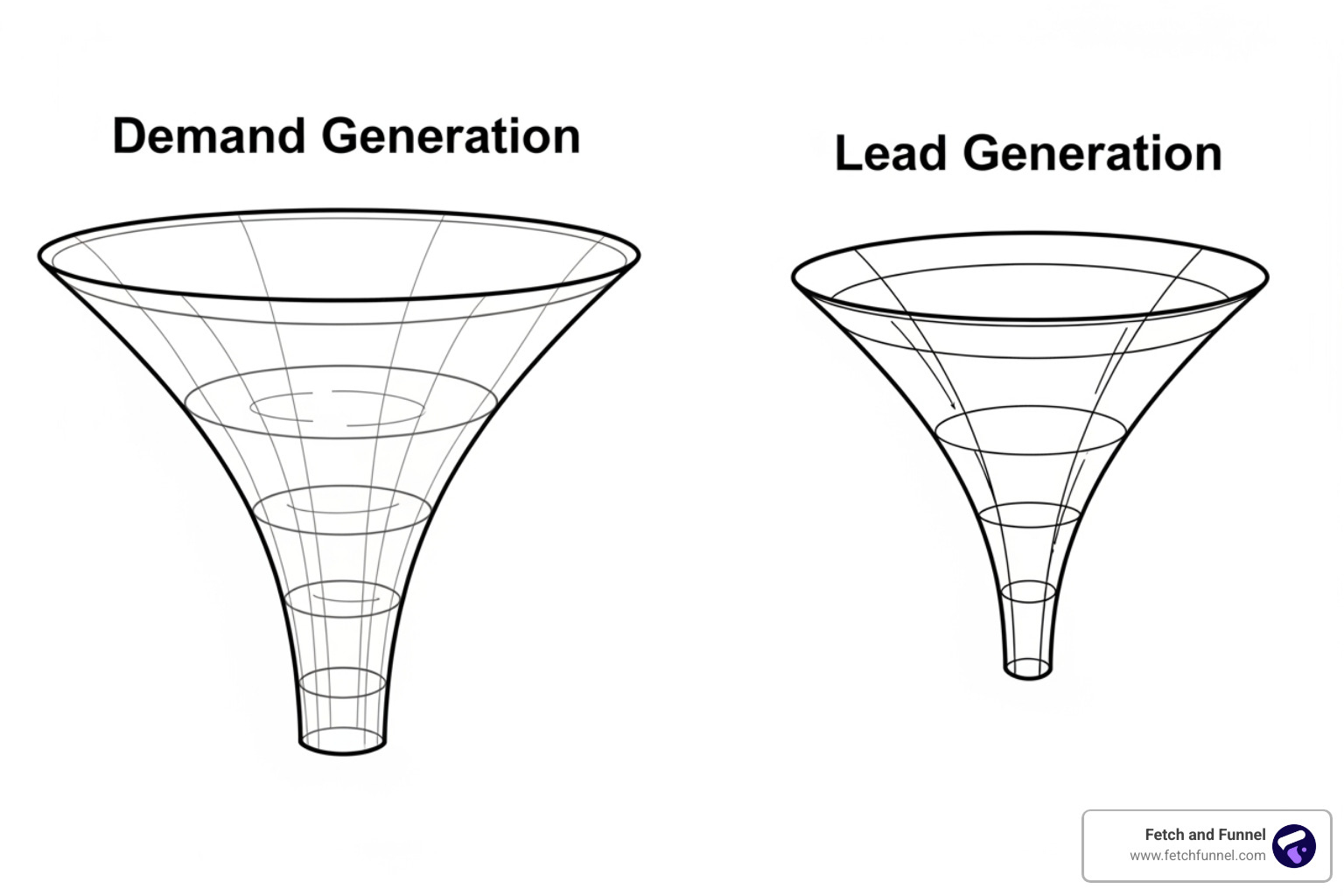
At Fetch and Funnel, we define full funnel demand generation as a holistic marketing system designed to cultivate interest and desire for a product or service, nurturing potential buyers from the earliest stages of problem awareness all the way through to becoming loyal advocates. It’s about creating a sustainable flow of qualified leads for your sales team, not just a large pipeline. This is a long-term, ongoing activity aimed at increasing inbound opportunities, warming up target accounts, and ultimately shortening the sales cycle while increasing the win rate. It’s truly a “system, not a tactic.”
In contrast, lead generation consists of short-term, sales-focused tactics designed to generate sales opportunities quickly, often from companies not actively buying. These tactics typically rely on volume, such as direct ads, gated PDFs followed by sales outreach, or webinars pitching a product. While lead generation can provide quick wins, it often leads to non-differentiated positioning, high Customer Acquisition Costs (CAC), and a decrease in performance over the long term. Many B2B companies still prefer lead generation because it’s easier and faster to launch, appears more scalable, offers direct attribution, and follows a linear funnel. However, the brutal truth is that this approach often focuses only on in-market buyers, which is the smallest segment of your audience.
Demand capture is a subset of demand generation that focuses on identifying engaged accounts that fit your Ideal Customer Profile (ICP) and demonstrate significant interest in your product or solution. This involves marketing to companies that are actively looking for a solution, using tactics like intent data, retargeting, and bottom-of-funnel content. It’s about converting existing intent, rather than creating it from scratch.
Why the Shift is Crucial
The modern B2B buyer journey is complex and often non-linear. It takes 222+ touchpoints on average to close a complex B2B deal, and many of these interactions happen outside traditional sales and marketing funnels—on social media, in private chats, or during internal meetings. With 90% of B2B decision makers never responding to cold outreach, relying solely on aggressive lead generation is a losing battle.
For B2B companies with long sales cycles and high Average Contract Value (ACV), full funnel demand generation is not just an option—it’s a necessity. It enables you to engage prospects earlier, build trust and credibility, and ensure your brand is top-of-mind when they are finally ready to make a purchase decision. This approach leads to higher quality leads, shorter sales cycles, and more profitable customer relationships.
Here’s a comparison to clarify the distinctions:
| Feature | Demand Generation “`
The Anatomy of a Full Funnel Demand Generation Model
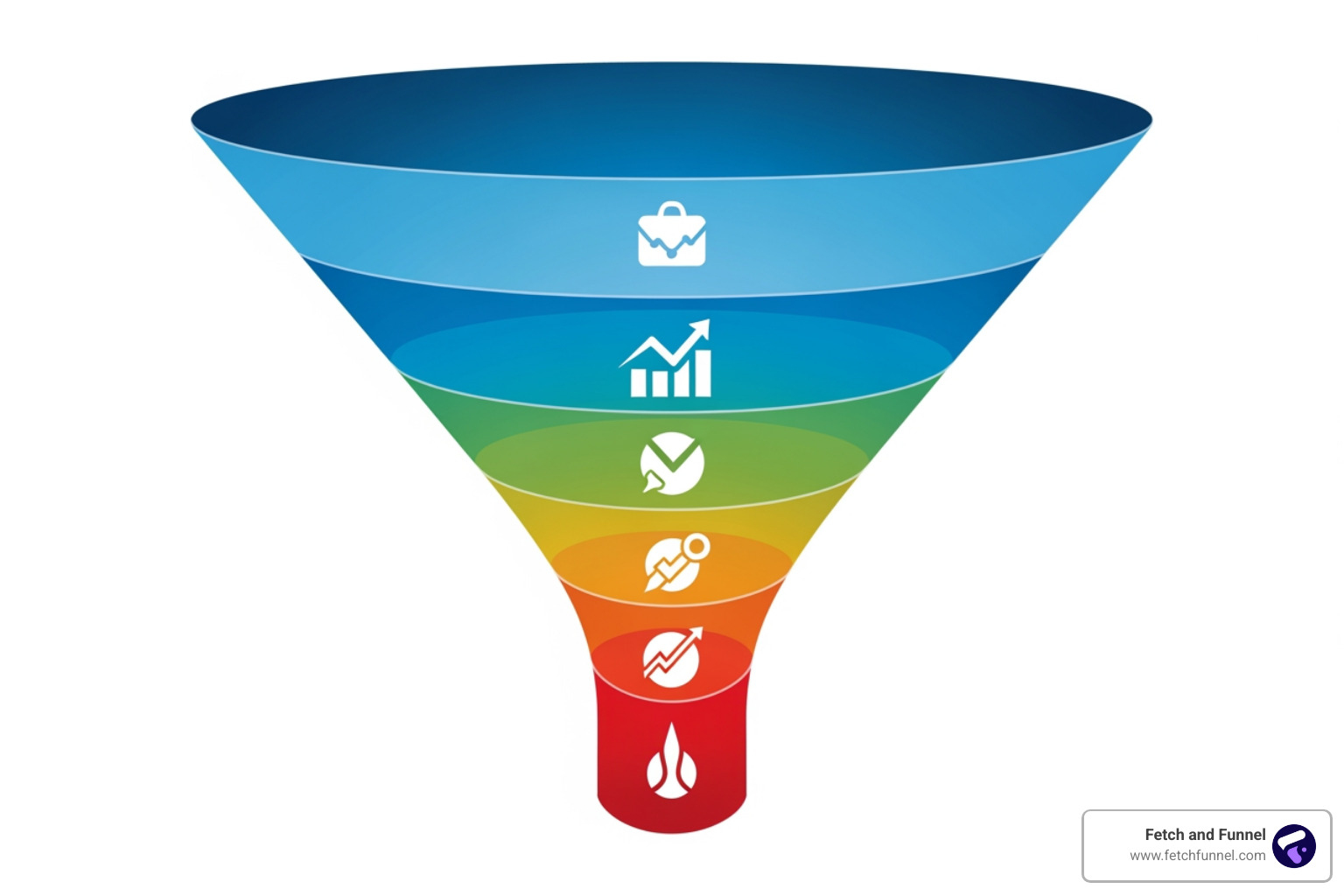
Understanding the stages of the buyer journey is the core of an effective full funnel demand generation strategy. We segment the funnel into four key phases: Awareness (TOFU), Consideration (MOFU), Decision (BOFU), and Post-Funnel. Each stage has unique goals, strategies, metrics, and content types designed to move prospects seamlessly towards becoming loyal customers and advocates.
Top of Funnel (TOFU): Creating Awareness & Generating Demand
At the very top of the funnel, our primary goal is to cast a wide net, educating and attracting a broad audience who might be experiencing a problem your solution addresses. This is where we build brand recognition and establish ourselves as thought leaders in the industry.
- Goal: Educate and attract a wide audience; Build brand recognition.
- Strategies:
- SEO (Search Engine Optimization): Ensuring your content ranks high for relevant keywords. For a deep dive, check out Moz’s Beginner’s Guide to SEO. Leads from search engines have a 14.6% close rate.
- Content Marketing: Creating valuable, ungated content that addresses audience pain points.
- Social Media: Engaging with audiences and sharing thought leadership on platforms like LinkedIn. 81% of buyers are more likely to engage with brands that have a strong, cohesive professional social media presence.
- Thought Leadership: Positioning ourselves as experts, often through articles, webinars, or speaking engagements.
- Podcasts: Hosting or appearing on industry-relevant podcasts to reach new audiences.
- Paid Promotion: Boosting top-performing content to target accounts via channels like LinkedIn Ads.
- Key Metrics: Website traffic, social media engagement, brand search volume, reach, impressions.
- Content Examples: Blog posts, infographics, videos, industry reports, whitepapers, social media posts, ungated guides.
Middle of Funnel (MOFU): Nurturing Consideration & Building Trust
Once prospects are aware of their problem and your brand, the MOFU stage focuses on nurturing their interest, positioning your solution as the best fit, and building unwavering trust. Here, we aim to capture intent signals and provide more in-depth information.
- Goal: Position your solution; Build credibility; Capture intent signals.
- Strategies:
- Webinars/Virtual Events: Demonstrating expertise and engaging with prospects in real-time.
- Case Studies: Showcasing how your solution has helped other businesses succeed.
- Email Nurturing: Delivering targeted, valuable content to segmented lists, often automated through platforms like HubSpot.
- Retargeting: Re-engaging website visitors or content downloaders with relevant ads.
- In-depth Guides & eBooks: Offering comprehensive resources in exchange for contact information (gated content, used strategically).
- Content Hubs: Providing solution-based content that enables buyers.
- Key Metrics: Lead magnet downloads, webinar registrations, Marketing Qualified Leads (MQLs), engagement score (e.g., content consumed, website pages visited), email open and click-through rates.
- Content Examples: Comparison guides, white papers, customer success stories, interactive tools, product feature deep-dives, free trials (early stage).
Bottom of Funnel (BOFU): Converting Demand into Revenue
This is where the rubber meets the road. The BOFU stage is all about driving purchase decisions and enabling your sales team to close deals efficiently. Prospects at this stage are highly engaged and actively evaluating solutions.
- Goal: Drive purchase decisions; Enable the sales team.
- Strategies:
- Demos: Personalized demonstrations of your product or service.
- Free Trials/Pilots: Allowing prospects to experience your solution firsthand.
- Consultations: Offering expert advice custom to their specific needs.
- Pricing Pages & Quotes: Providing clear information on cost and value.
- Sales Enablement: Equipping your sales team with relevant content, battle cards, and personalized insights. 62% of B2B customers respond to salespeople who connect by sharing content and insights that are relevant to the buyer.
- Account-Based Marketing (ABM): Highly personalized outreach to key decision-makers within target accounts, often powered by platforms like Demandbase.
- Key Metrics: Demo requests, Sales Qualified Leads (SQLs), pipeline created, conversion rates (from SQL to won deal), sales velocity.
- Content Examples: ROI calculators, implementation guides, product demos, personalized proposals, customer testimonials, competitive comparisons.
Post-Funnel: Fostering Loyalty & Driving Advocacy
Our work doesn’t end at the sale! The post-funnel stage is crucial for retaining customers, driving expansion revenue, and changing satisfied clients into enthusiastic brand advocates. This creates a powerful flywheel effect for future full funnel demand generation.
- Goal: Retain customers; Create brand advocates; Drive expansion revenue.
- Strategies:
- Customer Success Programs: Proactive support and guidance to ensure customer satisfaction and value realization, a discipline championed by companies like Gainsight.
- Loyalty Programs: Rewarding long-term customers and encouraging repeat business.
- User Communities: Creating platforms for customers to connect, share knowledge, and feel part of a tribe.
- Referral Programs: Incentivizing satisfied customers to recommend your solution.
- Onboarding and Training: Ensuring smooth adoption and proficiency with your product.
- Key Metrics: Customer Lifetime Value (LTV), Net Promoter Score (NPS), churn rate, customer satisfaction (CSAT), expansion revenue, referral rates.
- Content Examples: Advanced user guides, customer-only webinars, best practice playbooks, community forums, success stories, case studies for internal use, product roadmap updates.
Building Your High-Impact Full Funnel Demand Generation Engine
Building a robust full funnel demand generation program isn’t about throwing a bunch of tactics at the wall to see what sticks. It’s about constructing a strategic, systematic “engine” that drives predictable revenue growth. Let’s explore the practical steps we take at Fetch and Funnel to build and optimize these programs.
Step 1: Laying the Foundation with Data and Alignment
Any successful full funnel demand generation strategy begins with a solid foundation built on deep understanding and internal alignment.
- Defining your Ideal Customer Profile (ICP): Before you can generate demand, you need to know who you’re generating it for. We work with you to carefully define your ICP, going beyond demographics to understand their business challenges, goals, and decision-making processes. For a great template, check out HubSpot’s guide to creating an ICP. This ensures all subsequent efforts are highly targeted and efficient.
- Mapping the Modern Buyer Journey: As we’ve seen, buyers do most of their research independently. We map out their journey, identifying critical touchpoints, information needs, and triggers that move them from one stage to the next. This helps us understand where and how to best engage.
- The Critical Role of Data and Analytics: Data is the lifeblood of full funnel demand generation. We leverage advanced analytics to track engagement across channels, measure performance at each funnel stage, and gain insights into buyer behavior. This data-driven approach allows us to make informed decisions and continuously optimize. The average B2B buyer interacts with a brand 36 times before purchasing. Understanding these interactions is key.
- Establishing a Service Level Agreement (SLA): For full funnel demand generation to thrive, sales and marketing must be aligned. An SLA clearly defines expectations for lead quality, follow-up times, and shared responsibilities, fostering a collaborative environment.
- Shared KPIs between Sales and Marketing: We ensure both teams measure success using common metrics that reflect business outcomes, not just departmental goals. This might include pipeline created, conversion rates at each stage, and Customer Lifetime Value (LTV).
- Building a Feedback Loop: Regular communication between sales and marketing is vital. Sales provides crucial insights into lead quality and sales effectiveness, while marketing shares campaign performance and buyer intelligence. This continuous feedback fuels ongoing optimization.
Step 2: Integrating Advanced Strategies into your full funnel demand generation
Beyond the foundational elements, incorporating advanced strategies can boost your full funnel demand generation efforts.
- How Account-Based Marketing (ABM) Complements the Funnel: ABM is a highly effective strategy for B2B companies with high ACV and a finite list of target accounts. It flips the traditional funnel, focusing resources on pre-identified, high-value accounts. ABM doesn’t replace full funnel demand generation; it improves it by providing a hyper-targeted layer, especially in the MOFU and BOFU stages. We use ABM to deepen engagement with strategic accounts that have already shown some level of awareness or interest, often using platforms like Terminus to orchestrate these campaigns.
- Using Account-Based Content for Personalization: Generic content won’t cut it for ABM. We develop highly personalized content custom to the specific needs, challenges, and roles within each target account. This ensures relevance and accelerates the buyer’s journey.
- Leveraging Social Selling: Your sales team can be powerful demand generators. We empower them to engage strategically on platforms like LinkedIn, sharing valuable insights and building relationships. 92% of B2B customers are willing to engage with sales reps who have positioned themselves as an industry thought leaders. This isn’t cold calling; it’s about being a helpful resource.
- Building Thought Leadership: Becoming a recognized expert in your field creates organic demand. We help you develop and distribute content that positions your brand and key personnel as trusted voices, attracting an audience long before they’re ready to buy. 86% of enterprise buyers shortlist vendors they had heard of before starting their research process. This highlights the power of brand awareness.
Step 3: Overcoming Challenges and Transitioning Your Model
Shifting to a full funnel demand generation model isn’t without its problems. Many companies face common challenges, but with the right approach, they can be overcome.
-
Common Challenges:
- Budget Constraints: Only 24% of CMOs say they have sufficient budget to execute their 2024 strategy. This often forces a focus on short-term, easily attributable lead generation tactics.
- Attribution Complexity: Measuring the impact of every touchpoint across a long, non-linear buyer journey can be daunting.
- Lack of Executive Buy-in: Convincing leadership to invest in a long-term strategy when they’re accustomed to immediate lead volume can be tough.
- Internal Silos: Sales and marketing teams often operate independently, hindering seamless customer journeys.
-
Solutions:
- Start with a Pilot Program: We recommend launching small, focused pilot programs to test and prove the value of a full funnel demand generation approach. This allows for learning and iteration before a full-scale rollout.
- Use Blended Attribution Models: Instead of relying on single-touch attribution, we implement models that credit multiple touchpoints across the buyer journey, providing a more accurate picture of ROI. Marketing analytics platforms like Ruler Analytics offer different models to consider.
- Build a Business Case: Present a clear, data-driven case to leadership, highlighting the long-term benefits of full funnel demand generation—higher quality leads, lower CAC, and increased LTV—using projections and pilot program results.
Here are the key steps to transition from a lead generation to a full funnel demand generation model:
- Accept Existing Challenges: Acknowledge that the current lead generation approach has limitations.
- Define Clear Goals & Objectives: Set SMART goals that align with creating demand and building long-term relationships, not just MQL volume.
- Conduct Deep Customer Research: Understand the buyer journey, pain points, and preferred content formats.
- Categorize Demand Topics: Identify content themes that address business triggers, demand triggers, solution evaluation, and decision-making.
- Develop a Comprehensive Content Strategy: Map content to each stage of the funnel, prioritizing value over gated forms.
- Implement Proactive Content Distribution: Don’t just create content; actively promote it where your audience lives (social, communities, partnerships).
- Refine Demand Capturing: Identify engaged accounts and provide buyer enablement resources without premature sales pitches.
- Align Sales and Marketing: Establish clear SLAs, shared KPIs, and a continuous feedback loop.
- Launch Pilot Campaigns: Start small, measure leading indicators, and iterate based on results.
- Build a Demand Generation Team: Invest in the right talent and expertise to maintain and scale the function.
- Cultivate a Long-Term Mindset: Understand that full funnel demand generation is an investment with compounding returns, much like Warren Buffett’s wealth accumulation.
The Future of Full Funnel Demand Generation
The landscape of B2B marketing is constantly evolving, and full funnel demand generation is at the forefront of innovation. The future promises even more sophisticated, data-driven, and customer-centric approaches.

- The Role of AI and Predictive Analytics: Artificial Intelligence (AI) and predictive analytics are no longer futuristic concepts; they are powerful tools changing full funnel demand generation. They can analyze vast amounts of data to predict customer behaviors, identify high-value prospects, and automate lead scoring and segmentation. Companies like 6sense are at the forefront of using AI to uncover buying signals. AI can help us surface key accounts and decision-makers, allowing for more precise targeting. However, AI is only as effective as the strategy behind it; it cannot replace authentic, person-to-person connections.
- Content Personalization at Scale: With AI, we can move beyond basic segmentation to deliver hyper-personalized content experiences across all channels. This means tailoring messages, formats, and even timing based on individual buyer intent signals and preferences, making every interaction feel unique and relevant.
- Hyper-targeting Across Channels: The future of full funnel demand generation involves leveraging data to hyper-target audiences across every touchpoint. This includes dynamic ad targeting, personalized email sequences, and even customized website experiences based on industry, job title, and past interactions.
- The Rise of Generative Engine Optimization (GEO): As AI-powered search, chatbots, and large language models become more prevalent, optimizing your content for these “generative engines” will be crucial. GEO, a concept gaining traction, ensures your brand and solutions are visible and accurately represented in AI-driven answers, chat interactions, and other emerging platforms where buyers increasingly begin their research. You can learn more about this emerging field from resources like Search Engine Land.
- Ethical Marketing and Building Trust: In an era of increasing data privacy concerns, ethical marketing and transparency are becoming business imperatives. We anticipate a greater focus on compliant lead generation practices, clear opt-in/out policies, and the establishment of “Trust Centers” to demonstrate data handling policies and privacy certifications. Companies that accept transparency and ethical marketing not only see higher engagement rates but also stronger brand loyalty.
- The Importance of Community Building in B2B: B2B buyers don’t just want solutions; they want to connect with peers and learn from experts. Niche communities, industry associations, and forums provide invaluable platforms for peer learning and brand building. Companies like Salesforce have built massive engagement through their Trailblazer Community. Engaging authentically in these spaces fosters trust and positions your brand as a valuable resource, creating organic demand and advocacy.
Frequently Asked Questions about Full Funnel Demand Generation
What are the most important metrics for a full funnel demand generation program?
Measuring success in full funnel demand generation requires looking beyond single metrics. We focus on a comprehensive set of KPIs across each stage:
- TOFU Metrics (Awareness): Reach, Impressions, Website Traffic (unique visitors), Social Media Engagement (likes, shares, comments), Brand Mentions, Brand Search Volume.
- MOFU Metrics (Consideration): Lead Magnet Downloads, Webinar Registrations, Marketing Qualified Leads (MQLs), Engagement Score (e.g., content consumption, time on site), Email Open and Click-Through Rates.
- BOFU Metrics (Decision): Sales Qualified Leads (SQLs), Pipeline Value, Conversion Rates (MQL to SQL, SQL to Won), Sales Velocity, Customer Acquisition Cost (CAC).
- Post-Funnel Metrics (Advocacy): Customer Lifetime Value (LTV), Net Promoter Score (NPS), Churn Rate, Expansion Revenue, Customer Satisfaction (CSAT), Referral Rates.
- Overall Business Metrics: Revenue Influence (how marketing contributes to closed-won deals), LTV:CAC Ratio (a key indicator of business health).
How long does it take to see results from a full funnel strategy?
Full funnel demand generation is a long-term play, not a quick fix. While early indicators like increased website traffic and social engagement can appear within 3-6 months, significant pipeline and revenue impact typically takes 9-12+ months, especially for B2B businesses with long sales cycles and high ACV. The results compound over time, building a stronger brand and more predictable revenue stream. Patience and consistency are key.
What does a demand generation consulting engagement typically involve?
A demand generation consulting engagement with Fetch and Funnel focuses first on strategy before jumping into execution. We conduct a strategic audit of your Go-to-Market foundation, including a deep dive into your ICP, messaging, and sales infrastructure. This involves mapping your unique buyer journey, identifying opportunities for improvement, and recommending a tech stack that aligns with your goals. We then help you create a pilot program strategy, defining core programs for awareness, demand generation, and demand capture, complete with clear metrics and playbooks. The goal is to provide a clear, actionable path forward for implementation, whether you execute it in-house or with our continued support. Learn more about demand generation consulting.
Conclusion
The shift to full funnel demand generation marks a pivotal moment for B2B businesses. It’s a customer-centric system that aligns perfectly with modern buyer behavior, moving beyond the outdated tactics of traditional lead generation. By focusing on creating demand, building trust, and nurturing relationships across every stage, you’re not just chasing leads—you’re building a sustainable revenue engine.
This approach delivers numerous benefits: a higher quality pipeline, lower Customer Acquisition Costs (CAC), increased Customer Lifetime Value (LTV), and a stronger, more resilient brand. At Fetch and Funnel, we specialize in helping businesses in Boston, MA, and beyond, steer this complex landscape, developing and implementing performance-driven full funnel demand generation strategies that maximize ROI.
Ready to build a revenue engine that scales? Explore how our full-funnel marketing agency services can help you move from chasing leads to creating predictable demand.