

Geofencing advertising platform is a term that’s increasingly important in today’s digital marketing landscape. Essentially, it involves using virtual perimeters around specific locations to engage customers with personalized, location-based ads. This method offers targeted and timely messages, enhancing connection with potential customers right where they are.
- Targeted Ads: Direct messages based on a customer’s location.
- Improved Conversion Rates: Reach customers when they’re most likely to engage.
- Cost-Effective Strategies: Efficient use of ad spend by targeting specific areas.
Location-based marketing is revolutionizing how businesses connect with their audiences, providing unparalleled opportunities to influence consumer behavior at the exact place and time it matters most. Imagine reaching your customer as they stand right outside a competitor’s store or receiving a special deal message when they are near your own storefront. It’s about combining time, place, and personalized content for maximum impact.
As the founder of FetchFunnel.com, I’m Samir ElKamouny, a marketing expert dedicated to helping businesses succeed with cutting-edge strategies like the geofencing advertising platform. I’ve helped countless brands improve their ROI through effective, data-driven digital marketing solutions. Let’s dive deeper into understanding how geofencing marketing works and how it can become a game-changer for your business.

Geofencing advertising platform word list:
– how can i use geofencing to market real estate
– what is geofencing marketing on google
Understanding Geofencing Advertising
Geofencing is a powerful tool in digital marketing. It involves creating a virtual boundary around a specific geographic location. When a mobile device enters or exits this area, it triggers location-based ads. This technology allows businesses to deliver personalized messages directly to potential customers based on their real-world behavior.
How Geofencing Works
Imagine drawing an invisible circle around a store, event, or neighborhood. This is your geofence. When someone with a smartphone crosses this line, they might receive a push notification or see an ad related to that location. For example, a coffee shop could send a discount alert to anyone who enters their geofenced area during the morning rush hour.
Key Features:
– Customizable Boundaries: Geofences can be as small as a single building or as large as a city block.
– Real-Time Engagement: Ads are triggered instantly, ensuring timely communication.
– Data-Driven Insights: Marketers can track how many people enter the geofenced area and how they interact with the ads.
The Power of Location-Based Ads
Location-based ads offer unparalleled precision. They allow businesses to target customers who are already nearby, making them more likely to visit or make a purchase. This method is not just about reaching people; it’s about reaching the right people at the right time.
Consider the case of American Eagle, which used geofencing to send targeted messages at peak shopping times. They found that location, combined with the time of day, significantly influenced purchasing decisions.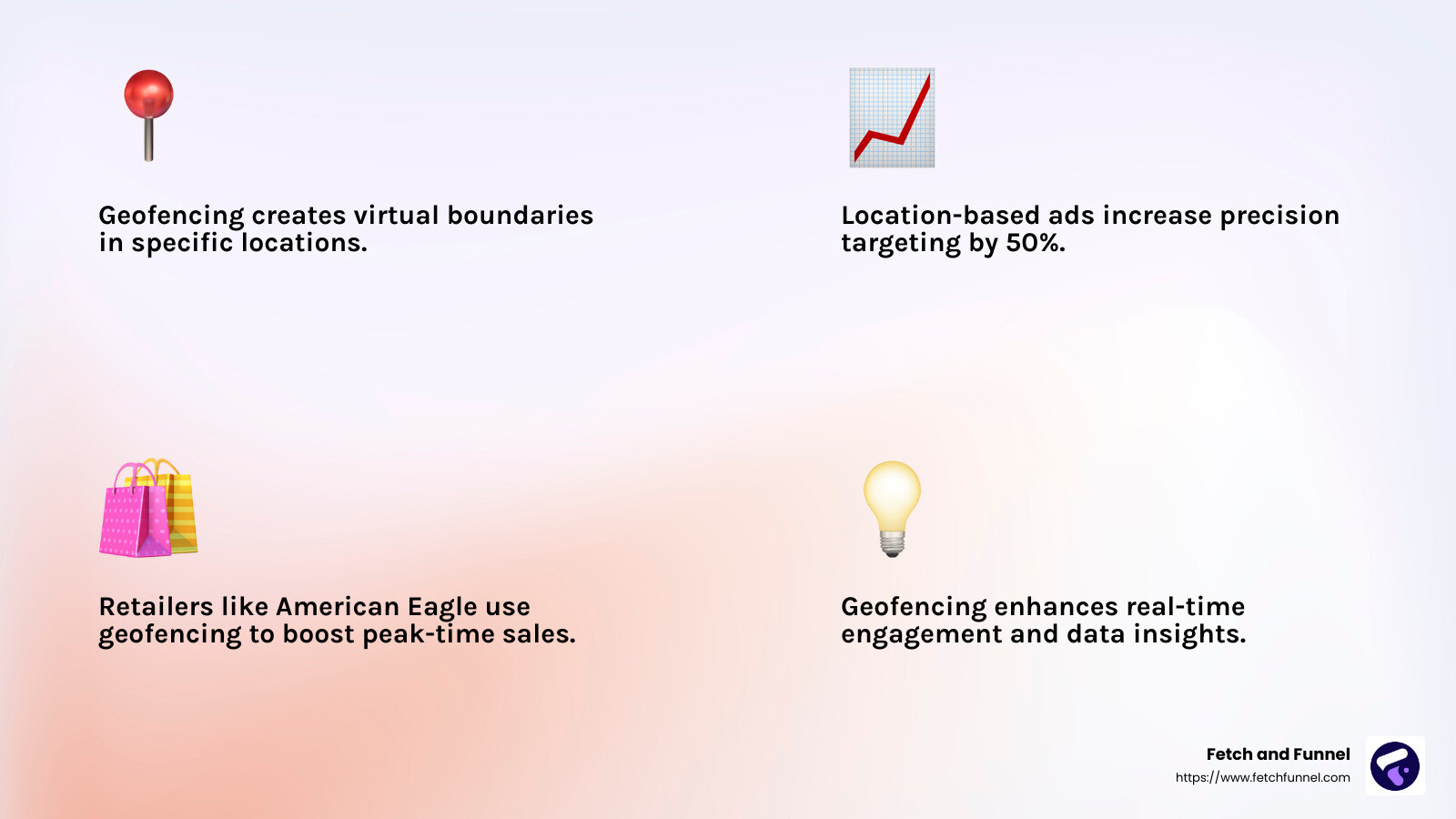
Benefits of Geofencing
- Improved Engagement: By delivering relevant messages based on location, businesses can increase customer interaction.
- Increased Foot Traffic: Geofencing can drive more people to physical locations, boosting sales and visibility.
- Efficient Ad Spend: By focusing on specific areas, businesses can maximize the impact of their marketing budgets.
Geofencing is changing the way companies approach advertising, providing a direct line to potential customers. In the next section, we’ll explore the key features of effective geofencing advertising and how they can be harnessed to improve marketing strategies.
Key Features of Effective Geofencing Advertising
Precision Targeting
Effective geofencing advertising hinges on precision targeting. At its core, this involves using advanced geofencing software to define highly accurate location boundaries. Unlike conventional methods that use broad radius fences, modern platforms implement sophisticated polygon geofences. This allows for pinpoint accuracy, down to a single meter, enabling businesses to target specific areas such as store walls or parking lots.
When businesses harness this technology, they observe that location, paired with the right timing, can significantly boost purchase behavior. This demonstrates the power of precise location-based targeting in driving real-world results.
Customization
Customization is a hallmark of effective geofencing advertising. Platforms now offer self-service advertising options, allowing businesses to create custom campaigns tailored to their unique needs. This level of customization ensures that businesses can adapt their strategies to fit specific objectives and audience preferences, ultimately leading to more efficient and impactful advertising efforts.
Integration with AI
The integration of AI functionality into geofencing platforms is revolutionizing how businesses engage with their audiences. AI enables the analysis of hyper-local trends, providing insights into consumer behavior that were previously unattainable. By understanding these patterns, businesses can optimize their campaigns to reach audiences when they are most likely to convert.
For example, AI can help identify the optimal time of day to send push notifications based on past consumer interactions, ensuring that messages are delivered when they are most relevant and effective.
Engagement Tools
Engagement is key in geofencing advertising, and tools like geotracking and push notifications are essential. Geotracking allows businesses to monitor the movement of potential customers, providing valuable data on foot traffic and consumer behavior. This information can be used to refine marketing strategies and improve customer engagement.
Push notifications offer a direct line to consumers, delivering timely and relevant messages that encourage interaction. Whether it’s a discount alert or a special offer, push notifications can significantly boost engagement and drive conversions.
Industry-Specific Solutions
Geofencing advertising is not a one-size-fits-all solution. Different industries can benefit from custom approaches. For instance, in the automotive sector, localized marketing strategies can be employed to target potential buyers near dealerships or competitor showrooms. By focusing on these specific areas, automotive businesses can increase foot traffic and improve sales.
These industry-specific solutions ensure that geofencing advertising is adaptable and effective across various markets, providing businesses with the flexibility to meet their unique needs and objectives.
In the next section, we’ll dig into the numerous benefits of geofencing advertising and how it can transform marketing strategies for businesses of all sizes.
Benefits of Geofencing Advertising
Geofencing advertising offers a host of benefits that can transform how businesses connect with their audience. Let’s explore some of these key advantages.
Precise Targeting
One of the standout benefits of a geofencing advertising platform is its ability to target audiences with incredible precision. By using advanced geofencing software, businesses can create virtual boundaries around specific locations, such as competitor stores or event venues. This precision ensures that ads reach the right people at the right time.
For example, when American Eagle used location-enabled campaigns, they finded that pairing location data with the time of day was a game-changer. Their targeted messages led to a 65% increase in purchase behavior, showcasing the power of precise targeting in driving sales.
Understanding Consumer Behavior
Geofencing advertising also provides valuable insights into consumer behavior. By tracking foot traffic and analyzing data, businesses can gain a deeper understanding of their audience’s preferences and habits. This information is crucial for tailoring marketing strategies that resonate with consumers on a personal level.
For instance, location data can reveal peak shopping times, allowing businesses to optimize their campaigns for maximum impact. As Rip Gerber from Locaid Technologies points out, knowing the best time of day for spending can significantly improve marketing effectiveness.
Real-World Results
The ultimate goal of any advertising strategy is to achieve tangible results, and geofencing delivers just that. By targeting specific locations and leveraging consumer insights, businesses can drive real-world outcomes, such as increased foot traffic and higher sales conversions.
The real-world results of geofencing advertising are evident in the success stories of companies like American Eagle, which saw measurable shifts in customer behavior thanks to location-based campaigns. With geofencing, businesses can connect with their audience in meaningful ways, leading to improved ROI and business growth.
In the upcoming section, we’ll dive into the costs associated with geofencing advertising and how businesses can effectively manage their ad spend.
Geofencing Advertising Platform Costs
When diving into geofencing advertising, understanding the costs involved is crucial. Let’s break down the key components: ad spend, management fees, and campaign extent.
Ad Spend
The beauty of geofencing is its flexibility in budget allocation. Businesses can start with a modest investment, often as low as a few hundred dollars, and scale up as needed. This makes it accessible for small businesses and large corporations alike. However, for optimal results, experts recommend allocating at least $1,000 per month. This allows for testing different placements, targeting options, and channels, ensuring your ads reach the right audience.
Management Fees
Management fees can vary depending on the service provider and the complexity of the campaign. Some platforms offer self-service options, which allow businesses to control their campaigns with ease and minimal additional costs. This can be a cost-effective choice for those who prefer hands-on management and have the expertise to handle campaign nuances.
For those seeking more comprehensive support, full-service agencies might charge higher fees but offer a wealth of expertise and resources. These agencies handle everything from campaign setup to performance analysis, freeing businesses to focus on other priorities.
Campaign Extent
The extent of your campaign—how far and wide you want your ads to reach—also influences costs. A campaign targeting a small, local area will generally cost less than one aiming to cover multiple cities or regions. The use of advanced features, such as AI integration for hyper-local trends, can further affect pricing but often provide greater returns by enhancing targeting precision and engagement.
Choosing the right campaign extent involves balancing your budget with your advertising goals. By carefully planning your geofencing strategy, you can maximize the impact of your ad spend while keeping costs in check.
In the next section, we’ll address some frequently asked questions about geofencing advertising to further explain this powerful marketing tool.
Frequently Asked Questions about Geofencing Advertising
What is geofencing advertising?
Geofencing advertising is a form of location-based marketing that uses virtual boundaries, or “geofences,” to target specific geographic areas. When a mobile device enters or exits this predefined geographic radius, it triggers ads or notifications. This method allows businesses to send relevant messages to potential customers based on their real-world location, enhancing the likelihood of engagement and conversion.
How much does geofencing advertising cost?
The cost of geofencing advertising can vary widely depending on several factors. Ad spend is one of the primary considerations. Businesses can start with a small budget, often a few hundred dollars, but it’s generally recommended to allocate at least $1,000 per month for effective testing and optimization.
Management fees are another component. These can differ based on whether you choose a self-service platform or a full-service agency. Self-service options might have lower fees but require more hands-on management. Full-service agencies, while potentially more expensive, offer comprehensive support and expertise, handling everything from setup to analysis.
Is geofencing marketing legal?
Yes, geofencing marketing is legal, but it must comply with various state laws and data regulation policies. Businesses need to ensure they are respecting user privacy and adhering to laws such as the General Data Protection Regulation (GDPR) in Europe or the California Consumer Privacy Act (CCPA) in the United States. It’s crucial to obtain proper consent from users and provide clear information about data usage to avoid legal issues. Always stay informed about the latest regulations to ensure your geofencing campaigns remain compliant.
In the next section, we’ll conclude by exploring how Fetch and Funnel can help you create high-converting digital marketing campaigns.
Conclusion
At Fetch and Funnel, we specialize in crafting high-converting digital marketing strategies that leverage the power of geofencing. Our approach centers on delivering creative solutions that are both data-driven and custom to improve customer experiences, ultimately increasing your return on investment (ROI).
Why Choose Fetch and Funnel?
Expertise in Digital Marketing: Our team is skilled in full-funnel advertising and conversion rate optimization, ensuring your campaigns are not only effective but also efficient.
Data-Driven Strategies: We use the latest location-based technology to create custom virtual boundaries, allowing us to target potential customers with pinpoint accuracy. This means your ads reach the right people at the right time, boosting engagement and conversions.
High-Impact Creative: Our creative strategies are designed to capture attention and drive action. We focus on crafting messages that resonate with your audience, leading to higher conversion rates.
Located in Boston, MA, Fetch and Funnel is committed to helping brands scale profitably through innovative digital marketing solutions. Our geofencing advertising platform is a key tool in achieving this, providing the precision and customization needed to succeed in today’s competitive market.
Ready to transform your marketing efforts with geofencing? Find how Fetch and Funnel can help you reach your goals.


