

Open uping Location-Based Marketing Power
Ever had that magical moment when your phone seems to read your mind? You’re strolling past your favorite clothing store and—ding!—there’s a notification about the exact style of jeans you’ve been eyeing, now 30% off. That’s not mind-reading or coincidence—it’s geofencing mobile advertising at work.
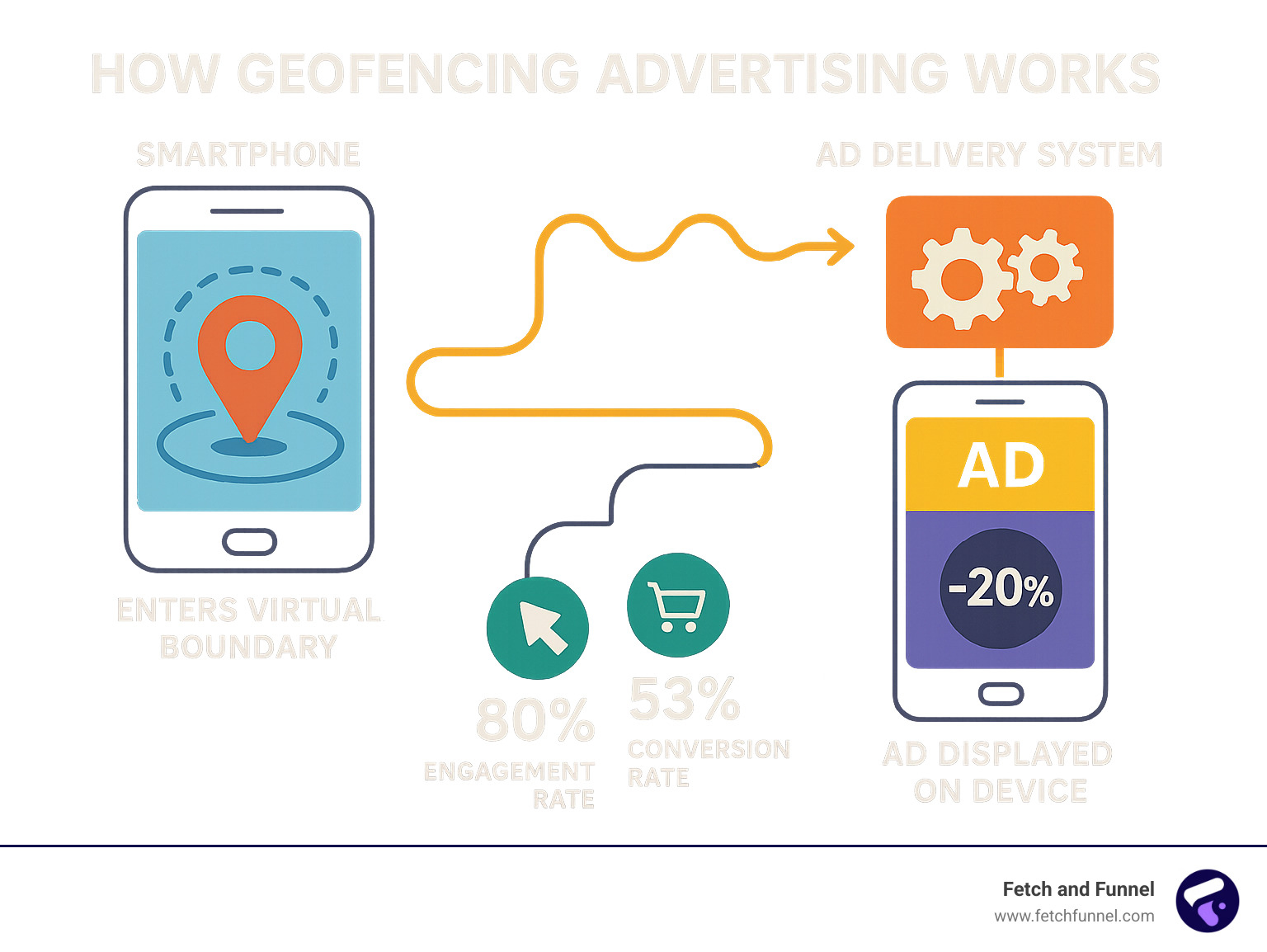
Geofencing mobile advertising creates invisible digital boundaries around physical locations that trigger targeted ads when someone crosses that virtual line. Think of it as a welcome mat that only you can see, inviting you in with personalized offers right when you’re nearby.
| What is Geofencing Mobile Advertising? | How It Works |
|---|---|
| A location-based advertising technique | Creates virtual boundaries using GPS, Wi-Fi, or Bluetooth |
| Delivers targeted mobile ads in real-time | Triggers when users enter or exit defined geographic areas |
| Works through apps, push notifications, SMS, or display ads | Uses opt-in location services on mobile devices |
| Average click-through rates of 0.5-1% | Typically costs $3.50-$15 per thousand impressions |
The numbers tell a compelling story: 80% of consumers are more likely to engage with personalized ads relevant to their location. Even more impressive, 53% are more likely to visit a store after receiving a location-based ad while nearby. That’s not just marketing—that’s creating opportunity at the perfect moment.
As founder of Fetch and Funnel, I’ve seen how geofencing mobile advertising transforms businesses. One coffee shop client increased foot traffic by 24% within just two months by targeting nearby office workers during afternoon slump hours. The power lies in the precision and timing.
What makes geofencing so valuable for your business? It’s all about relevance and results. Hyper-local targeting means you’re reaching people exactly when they’re in position to act. Real-time engagement creates immediate sales opportunities that might otherwise be missed. The improved personalization delivers offers that actually matter to people based on where they are. Plus, you’ll get measurable results tracking actual store visits and cost-effective advertising that focuses your budget only on high-potential customers.
Throughout this guide, I’ll share proven strategies we’ve implemented at Fetch and Funnel to help brands boost conversions and maximize their marketing ROI through precisely targeted location-based campaigns. Whether you’re new to geofencing mobile advertising or looking to refine your approach, you’ll find actionable insights to drive real business growth.
Want to dive deeper? Explore these essential aspects of geofencing:
– Geofencing ad targeting
– How does geofencing advertising work
– Geofencing Facebook ads
What Is Mobile Geofencing & Why It Matters
Imagine drawing an invisible fence around your favorite coffee shop. When you step inside that boundary, your phone lights up with a special offer for a free pastry with your latte purchase. That’s the magic of mobile geofencing in a nutshell!
At its core, geofencing mobile advertising creates virtual boundaries around physical locations. These digital perimeters can surround your business, a competitor’s store, a concert venue, or even a neighborhood park. When someone’s smartphone crosses this invisible line, it triggers a specific action – usually sending them a timely, relevant message or offer.
With Pew Research showing that 85% of Americans now carry smartphones, the potential reach of this technology is enormous. What makes geofencing mobile advertising truly special isn’t just its reach, though – it’s the precision and timeliness it offers.
Think about traditional advertising for a moment. You might see a billboard for a restaurant while driving home, but by then you’ve already eaten dinner. With geofencing, that same restaurant can send you a lunch special right as you’re walking through downtown at noon, stomach growling. That’s the power of right message, right place, right time marketing!
The results speak volumes about effectiveness:
– 71% of consumers are more likely to purchase when they receive location-relevant offers
– 82% have engaged with location-based mobile ads
– Geofence-based retargeting achieves click-through rates 10x higher than standard display ads
Geofencing mobile advertising creates those perfect micro-moments where your brand connects with customers exactly when they’re most receptive. It’s like having a friendly shop owner who recognizes you as you walk by and calls out a personalized greeting – except it scales to thousands of potential customers simultaneously!
How Geofencing Differs from Classic Geo-Targeting
While traditional geo-targeting might seem similar to geofencing, they’re as different as using a map versus having a personal tour guide. Regular geo-targeting casts a wide net over general areas like zip codes or cities, often using imprecise data like IP addresses.
Geofencing mobile advertising, however, offers four game-changing advantages:
First, it creates precision boundaries that can outline specific buildings or spaces. Rather than targeting an entire shopping district, you can create custom polygon shapes around just the stores most relevant to your business. This surgical precision eliminates wasted ad spend on people who aren’t truly in your target zone.
Second, it captures those golden micro-moments when purchase decisions happen. When someone walks into an auto dealership, they’re actively thinking about buying a car – making them incredibly receptive to your competing offer right then.
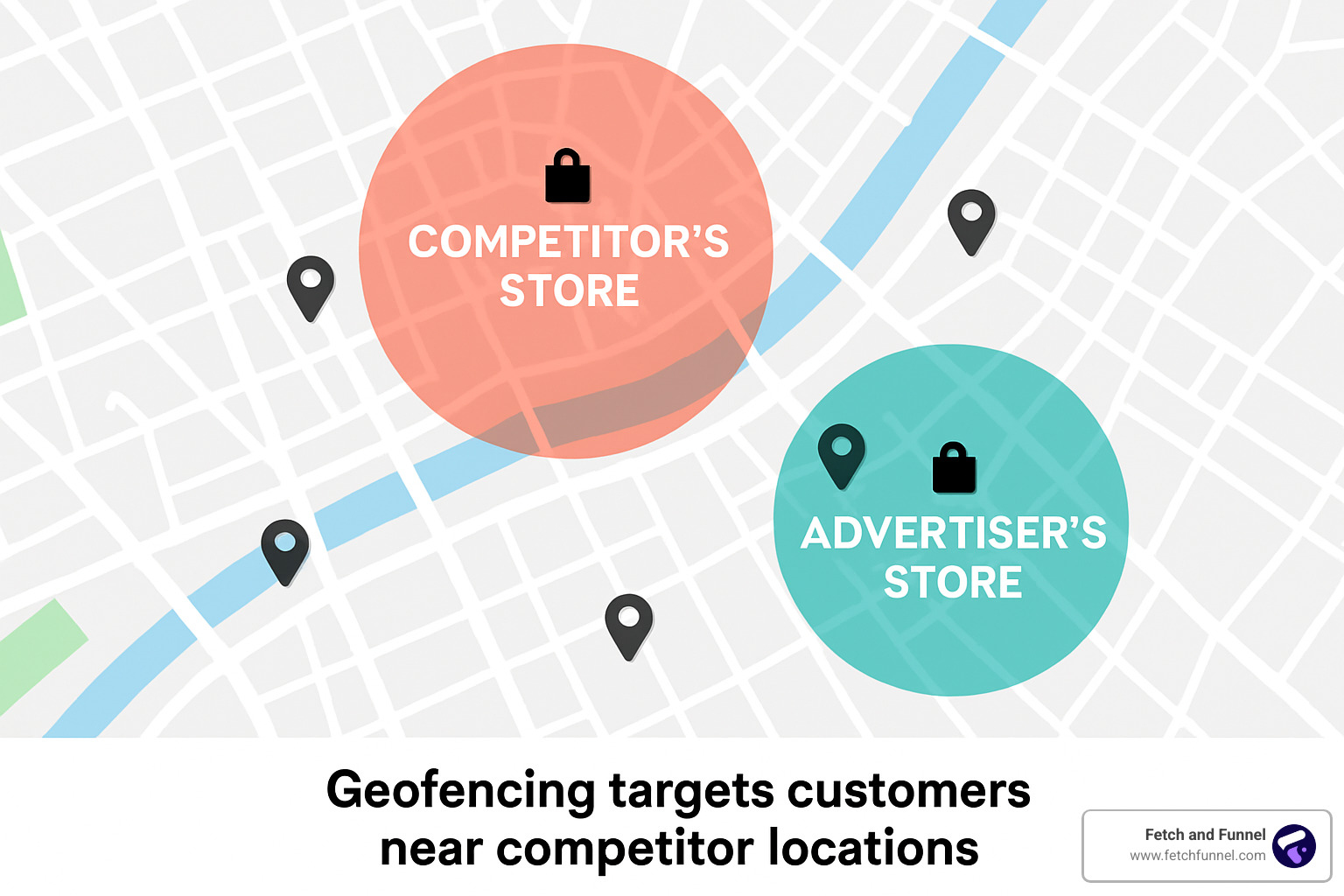
Third, it enables competitive conquesting – perhaps the most strategic application. By setting up geofences around your competitors’ locations, you can entice their customers to visit you instead. This approach allows you to present your unique value proposition at the perfect moment of decision.
Finally, modern geofencing incorporates behavioral triggers beyond simple entry and exit events. You can target people who linger in a location for a minimum time period (indicating genuine interest rather than just passing by), or who visit multiple times within a certain timeframe.
As one of our retail clients put it: “We used to blindly target entire ZIP codes. Now we focus only on the high-value locations where our best customers actually shop. We’ve gained better budget control, more custom messaging, and detailed insights into exactly which locations drive results.”
When implemented thoughtfully, geofencing mobile advertising transforms from a technical tool into a customer experience improver – delivering value to both your business and your audience at precisely the right moment.
Geofencing Mobile Advertising Technology Explained
The magic behind geofencing mobile advertising isn’t actually magic at all—it’s a blend of clever technologies working together to deliver the right message at exactly the right moment. Let me walk you through how this digital wizardry actually works in the real world.
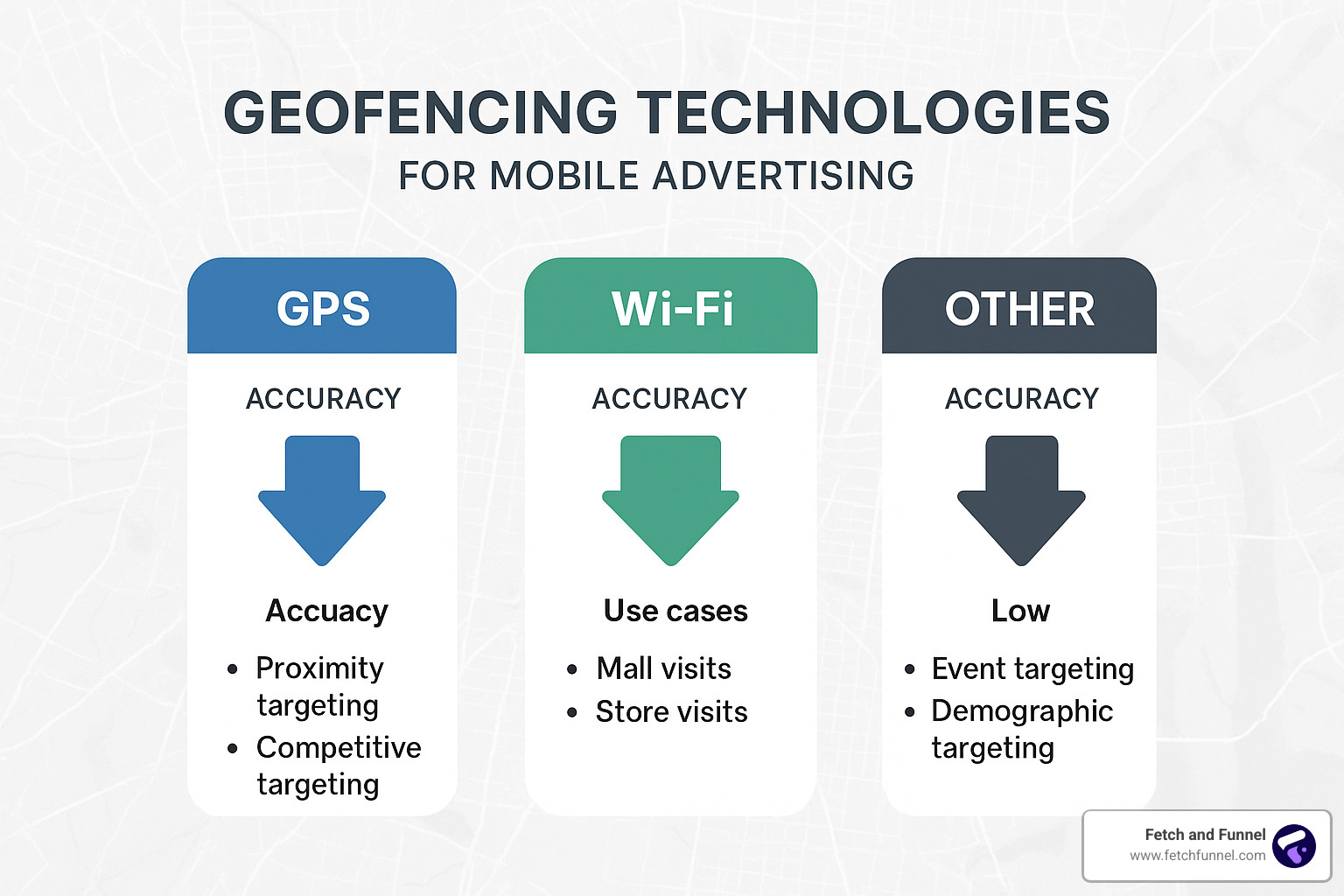
Ever wonder how your phone knows exactly where you are? It’s using one (or more) of these location-detection methods:
GPS is like the overachiever of the location technology world—incredibly precise (within 2-3 meters) but a bit of a battery hog. It works beautifully outdoors but gets confused when you step inside buildings.
Wi-Fi positioning is more of a team player, figuring out where you are by measuring signal strength from nearby wireless networks. It’s much friendlier to your battery and works great indoors, though it’s not quite as pinpoint accurate as GPS.
Bluetooth guides are the new kids on the block—small transmitters that can pinpoint your location down to a few feet, even indoors. They’re gentle on battery life but require businesses to install and maintain the physical guides.
RFID technology is the close talker of the bunch—it only works at extremely short ranges (we’re talking inches), making it perfect for event check-ins but less practical for most geofencing campaigns.
Cellular triangulation is the old reliable—it works anywhere you have cell service but with the tradeoff of being the least precise, sometimes only accurate to within several hundred meters.
| Technology | Accuracy | Battery Impact | Indoor Effectiveness | Infrastructure Needs |
|---|---|---|---|---|
| GPS | 2-3 meters | High | Poor | None |
| Wi-Fi | 15-40 meters | Medium | Good | Existing Wi-Fi |
| Bluetooth | 1-10 meters | Low | Excellent | Guide installation |
| RFID | Inches | Very Low | Excellent | Reader installation |
| Cellular | 100-1000 meters | Low | Fair | None |
Core Tech Stack for Geofencing Mobile Advertising
Behind every successful geofencing mobile advertising campaign is a symphony of technology working in perfect harmony:
Software Development Kits (SDKs) are the foundation—they integrate into mobile apps and handle all the behind-the-scenes work of detecting location, managing permissions, and displaying ads.
Ad servers act as the central brain, storing all your creative assets and decision rules about which ads should display when someone crosses into your virtual territory.
When you need to purchase ad space across multiple platforms simultaneously, Demand-Side Platforms (DSPs) come into play, often using real-time bidding to secure the best placements at the best prices.
For those attention-grabbing notifications that pop up on a phone’s lock screen, Push Notification Engines do the heavy lifting, delivering time-sensitive alerts the moment someone enters your geofenced area.
Tying everything together are Data Management Platforms (DMPs), which collect and organize audience data so you can target based not just on location but on past behaviors too—making your campaigns smarter and more effective.
Trigger Types in Geofencing Mobile Advertising
The beauty of geofencing mobile advertising lies in its flexibility. Your campaigns can be triggered in several different ways:
Static boundaries are the bread and butter of geofencing—simple virtual perimeters around physical locations that activate when someone crosses the line. Think of a coffee shop setting a 500-meter radius to catch morning commuters.
Sometimes it’s not about where you are but who you’re near. Peer-to-peer proximity triggers activate based on closeness to other mobile devices, perfect for festivals or sporting events where fans cluster together.
For businesses like ride-sharing apps, dynamic motion triggers respond to moving targets, letting you know when your driver is just around the corner.
Dwell-time filters are the more sophisticated cousin of static boundaries—they only activate after someone has lingered in a location for a certain amount of time, indicating genuine interest rather than just passing through. This prevents wasting impressions on people who are just walking by.
And when someone leaves your area? Exit retargeting kicks in, sending follow-up messages to encourage them to return or to complete a purchase online if they didn’t buy in-store.
As one of our geofencing experts at Fetch and Funnel often explains: “When a device with location services enabled enters a predefined ‘fence,’ an ad impression is secured and served in apps or mobile sites, commonly in gaming, weather, or news apps.”
The technology behind geofencing mobile advertising might be complex, but the concept is beautifully simple: reach people when they’re in exactly the right place to hear your message. And that’s something worth getting excited about.
Strategic Benefits & High-Impact Use Cases
Geofencing mobile advertising delivers numerous strategic advantages that can transform your marketing effectiveness. By connecting digital advertising directly to physical locations, businesses can create more relevant, timely, and measurable campaigns.
Hyper-Local Targeting
Imagine reaching only those customers who are literally steps away from making a purchase. That’s the power of hyper-local targeting with geofencing. Rather than casting a wide net based on demographics alone, you can deliver messages to people who are in exactly the right place at the right time.
A coffee shop owner once told me, “Since implementing geofencing, it feels like I’m personally inviting nearby pedestrians in for their morning cup.” This personal touch makes sense when you consider that industry experts recommend a four-to-five minute walking radius as the sweet spot for most retail geofencing campaigns. Beyond that distance, the immediacy and relevance begin to diminish.
Increased Engagement and Conversion Rates
The numbers don’t lie – when your ads connect with location context, people pay attention. The average click-through rate for geofencing mobile advertising typically ranges between 0.50-1%, which might not sound impressive until you compare it to standard display advertising rates that often hover below 0.1%.
This boost in engagement isn’t just digital smoke and mirrors. According to research by Verve, 71% of consumers said they were more likely to make a purchase when they received a personalized offer based on their location. Why? Because the offer feels relevant to their immediate needs and circumstances.
Foot Traffic Attribution
For years, marketers have struggled with the infamous “last mile” problem – connecting online advertising to in-store visits. Geofencing mobile advertising neatly solves this challenge by creating “conversion zones” at your physical locations.
When someone who viewed your ad later walks into your store, you can attribute that visit directly to your campaign. This closed-loop measurement transforms vague digital metrics into concrete foot traffic data, giving you confidence in your marketing ROI. At Fetch and Funnel, we’ve seen clients completely transform their marketing strategies once they can definitively track which campaigns drive actual store visits.
Omni-Channel Synergy
Geofencing doesn’t exist in isolation – it works best as part of an integrated marketing approach. The location intelligence you gather through geofencing campaigns can inform your email marketing, social media, and even direct mail efforts.
For example, a customer who visits your store but doesn’t make a purchase might receive a follow-up email with a special offer. Or someone who frequently visits a particular location might see social media ads custom to their apparent preferences. This creates a cohesive customer journey that feels personal and attentive across all touchpoints.
Real-World Campaign Wins
Strategic Location-Based Campaign
A major quick-service restaurant chain launched a groundbreaking location-based campaign. They geofenced strategic locations nationwide and offered customers a special menu item for just one penny – but only if they were physically near certain locations and then traveled to the restaurant to redeem it.
The innovative approach paid off spectacularly. The campaign drove over 1 million app downloads in just a few days, catapulting the restaurant’s app to the most downloaded position in the Apple App Store. More importantly, it physically diverted customers toward their locations – a marketer’s dream come true.
Quick-Service Restaurant Mobile Offers
A popular quick-service restaurant recognized that their younger demographic lives on their phones, so they implemented geofencing mobile advertising through their app to deliver timely offers when customers approached their locations. The simple strategy contributed to a 6% annual sales increase – translating to approximately $600 million in additional revenue. Not bad for a few well-timed notifications!
Retail Fashion Nightlife Push
Sometimes the magic of geofencing comes from understanding context beyond just location. A fashion retailer cleverly targeted women exiting nightclubs and bars with dress promotions during evening hours. By combining location with timing, they created highly relevant messaging that achieved a 75% conversion uplift and 146% revenue lift compared to their standard targeting approaches.
Assisted Living Facility Tours
Not all geofencing has to be about immediate purchases. An assisted living community targeted hospitals and emergency rooms with ads promoting their facilities. This thoughtful placement reached families during moments when long-term care decisions might be top of mind, generating 60 walk-ins and tours in just 30 days. The campaign demonstrated how geofencing mobile advertising can support complex, high-consideration purchases.
Gym Membership Boost
A fitness center employed strategic location targeting by placing geofences around nearby fitness facilities. Their ads highlighted specific advantages, resulting in 73 new memberships and approximately $38,000 in revenue. The beauty of this approach is its precision – reaching people who have already demonstrated interest in fitness services.
Where Geofencing Fits in Your Marketing Funnel
One of the most versatile aspects of geofencing mobile advertising is its ability to support every stage of the marketing funnel. At the awareness stage, you can introduce your brand to new prospects in relevant locations. For consideration, you might retarget users who have visited your location or other relevant areas. When it’s time for conversion, compelling offers can drive immediate store visits.
The relationship doesn’t end with the purchase. Geofencing can recognize and reward repeat visitors with loyalty promotions or encourage on-site customers to share their experiences and leave reviews.
We’ve seen at Fetch and Funnel how integrating geofencing mobile ads with broader marketing strategies creates a powerful multiplier effect. Location-based insights enrich your understanding of customer behavior, making all your marketing channels work harder and smarter.
For more inspiration and detailed case studies on how businesses like yours have leveraged geofencing for remarkable results, check out our Geofencing Case Studies collection.
Step-by-Step: Implementing a Winning Geofence Campaign
Successfully implementing geofencing mobile advertising requires careful planning and execution. Follow these steps to create effective campaigns that drive measurable results.

1. Set Clear Campaign Goals
Before launching any geofencing campaign, you need to know what success looks like. I always recommend starting with SMART goals that give your campaign direction and purpose.
Are you looking to drive more foot traffic to your store? Perhaps you want to increase sales of a specific product line? Maybe you’re aiming to steal some thunder from competitors? Whatever your aim, make it specific and measurable.
For example, instead of “increase store visits,” try: “Increase in-store visits by 15% among mobile users within a 5-mile radius over the next 30 days.” This gives you a clear target to aim for and measure against.
2. Research Your Target Audience
I can’t stress this enough – understanding who you’re targeting makes all the difference. Before drawing a single geofence, take time to really get to know your audience’s habits and movements.
Look at your existing customer data to spot patterns. Where do your best customers come from? When do they typically visit? Use location intelligence tools to map these journeys and identify promising areas to target.
As Sarah Gaffney, a geofencing expert, puts it: “Understanding who is likely to become a customer helps you target the right locations.” This insight will guide where you place your virtual boundaries for maximum impact.
3. Define Accurate Boundaries
The magic of geofencing mobile advertising lies in precision. Rather than casting a wide net, you’re creating targeted zones that capture the right audience at the right moment.
Polygon mapping gives you the flexibility to create custom-shaped boundaries around specific buildings or areas. This is far more effective than simple radius-based geofencing, which might waste impressions on people who aren’t truly near your target location.
When working with clients at Fetch and Funnel, we often recommend keeping geofences small – typically a four-to-five minute travel distance. This sweet spot ensures your message reaches people who can actually act on it immediately.
For retail clients, we sometimes use trade area analysis to identify where most customers actually come from, rather than assuming a standard radius. For urban locations, we might create isochrones based on walking time rather than distance, accounting for real-world factors like traffic patterns.
And don’t forget the power of competitor locations – setting up geofences around your competitors’ stores can be a game-changer for capturing market share.
4. Craft Compelling Creative & Offers
Even the most precisely targeted geofence won’t deliver results if your creative falls flat. Your message needs to grab attention and motivate immediate action.
Localized messaging makes all the difference. When someone sees an ad that references their specific location (“While you’re in Downtown Boston…”), it immediately feels more relevant and personal.
I’ve found that urgent calls-to-action work wonders for geofencing campaigns. Words like “Visit today,” “Stop by now,” or “Claim your in-store offer” create the sense of immediacy that drives foot traffic. The goal is to make the offer feel too good to pass up when the consumer is already nearby.
Don’t forget to test different creative approaches. What works in one location might not work in another, and seasonal factors can dramatically impact performance. We’ve seen clients double their conversion rates simply by tailoring messaging to current weather conditions.
5. Select the Right Technology Platform
Choosing the right platform for your geofencing mobile advertising depends on your specific needs and budget.
For smaller businesses just getting started, self-serve advertising platforms like Google Ads and Facebook offer basic geofencing capabilities that can be quite effective. They’re user-friendly and don’t require massive budgets to get started.
For more sophisticated campaigns, specialized geofencing providers offer improved precision and features. These platforms typically provide more detailed analytics and attribution models.
Some larger enterprises opt for custom app development with built-in geofencing capabilities. While this approach requires significant investment, it provides the most control over the user experience.
At Fetch and Funnel, we help our clients steer these options based on their specific goals and resources. The right choice isn’t always the most expensive one – it’s the one that delivers the best ROI for your unique situation.
6. Set Up Privacy Compliance
In today’s privacy-conscious world, respecting user data is non-negotiable. Every geofencing mobile advertising campaign must prioritize privacy compliance.
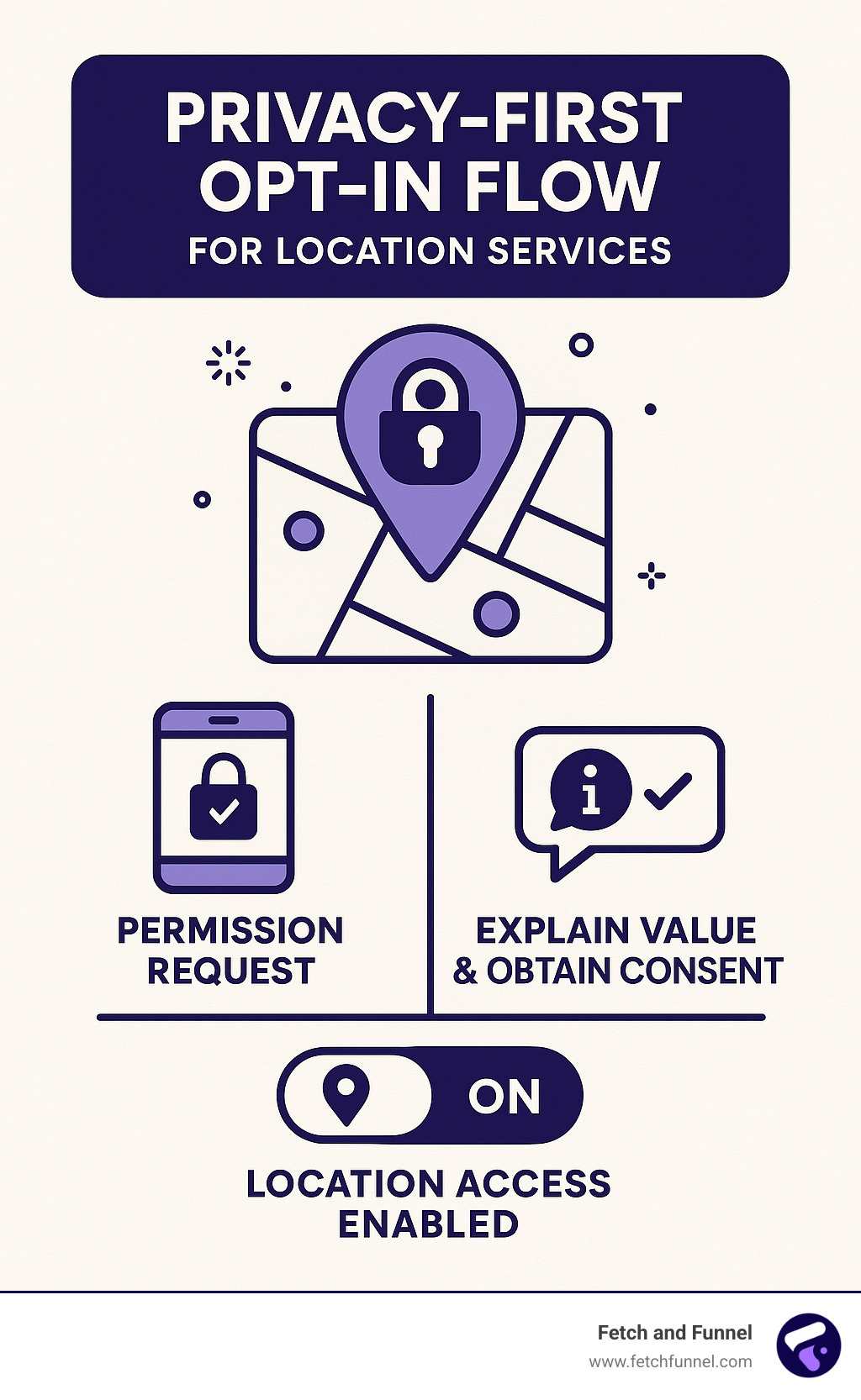
Always ensure users have clearly opted in to location tracking, provide transparent privacy policies, and comply with relevant regulations like GDPR and CCPA. Implementing data minimization practices and offering simple opt-out mechanisms builds trust with your audience.
As one digital marketing expert puts it: “Be transparent about data usage to respect customer privacy. Clearly communicate the value exchange for sharing location data.” When users understand what they’re getting in return for their location data, they’re much more likely to participate willingly.
7. Launch, Monitor & Optimize
Once your campaign is live, the real work begins. Successful geofencing requires continuous monitoring and optimization.
Track key performance metrics in real-time and be ready to make adjustments. Are certain locations outperforming others? Shift more budget there. Is a particular creative message driving higher engagement? Expand its use across more geofences.
The beauty of digital marketing is that you can refine your approach based on actual performance data. Don’t be afraid to adjust geofence boundaries, refine targeting parameters, or tweak creative elements as you learn what works.
For more detailed information on targeting options, visit our guide on geofencing ad targeting.
Budgeting & Pricing Models
Understanding the cost structure of geofencing mobile advertising helps you set realistic budgets and expectations.
Most campaigns operate on a CPM (Cost Per Thousand Impressions) basis, typically ranging from $3.50 to $15 per thousand impressions. This pricing model works well for awareness-focused campaigns where you’re trying to reach a broad audience within your geofence.
Some platforms offer CPV (Cost Per Visit) pricing, where you pay only when users physically visit your location after seeing your ad. This model directly ties your spending to actual foot traffic results – a powerful option for retailers and restaurants.
In our experience at Fetch and Funnel, the average monthly spend on effective geofencing campaigns ranges from $10,000-$15,000, though this can scale up or down based on your business size and objectives. What matters most isn’t how much you spend, but the return on that investment.
When calculating ROI, use this simple formula: ROAS (Return on Ad Spend) = Revenue Generated ÷ Ad Spend. A ROAS greater than 1 indicates profitability, while below 1 means you’re losing money on the campaign.
Measuring Success & Continuous Optimization
Effective measurement is crucial for maximizing the ROI of your geofencing mobile advertising campaigns. By tracking the right metrics and continuously optimizing, you can significantly improve performance over time.
Key Performance Indicators
When I work with clients on geofencing mobile advertising, I always emphasize that what gets measured gets improved. Let’s explore the essential metrics that truly matter for your campaigns.
Your click-through rate (CTR) tells you how compelling your ad is at first glance. For geofencing display campaigns, you should aim for 0.50-1% – and don’t worry if that sounds low! It’s actually significantly higher than standard display advertising. Calculate it by dividing clicks by impressions and multiplying by 100.
Store visits are where digital meets physical. This metric shows you how many people actually walked into your location after seeing your ad. It’s the real-world proof that your digital efforts are working. I’ve seen clients absolutely light up when they see these numbers climbing!
Dwell time adds another layer of insight. It’s not just about getting people through the door – it’s about how long they stay. Longer dwell times usually mean higher engagement and stronger purchase intent. One restaurant client finded their geofencing campaigns were bringing in customers who stayed 23% longer than their average visitor.
Your conversion rate measures the percentage of users who complete your desired action after clicking your ad or visiting your location. Whether that’s making a purchase, signing up for your newsletter, or requesting more information, this metric ties directly to your bottom line.
Return on ad spend (ROAS) is where the rubber meets the road financially. By dividing your revenue by your ad spend, you get a clear picture of your campaign’s profitability. A ROAS greater than 1 means you’re making money, while anything less means you’re losing it.
Don’t overlook view-through attribution. Many customers see your ad, don’t click, but still visit your store later. Without tracking this metric, you might severely underestimate your campaign’s effectiveness.
Advanced Measurement Techniques
Taking your measurement to the next level means implementing more sophisticated tracking methods. Cross-device attribution helps you understand how customers interact with your brand across multiple devices before making a purchase decision. This creates a complete picture of the customer journey from initial ad exposure to in-store visit.
Offline sales matching connects your point-of-sale data with ad exposure to measure actual purchase behavior. One retail client was shocked to find that their geofencing mobile advertising was driving 32% more revenue than they initially thought once we implemented this technique.
Control group testing compares results between geofenced areas and similar non-geofenced areas. This scientific approach isolates the true impact of your campaign by controlling for other variables. It’s like having a marketing laboratory where you can prove what’s really working.
Turning Data into Action
The true magic happens when you transform these insights into strategic improvements. I’ve seen campaigns double their effectiveness through thoughtful optimization.
Segment refinement helps you focus your budget where it works hardest. By analyzing which audience segments respond best to your geofencing ads, you can adjust targeting accordingly. One fitness club finded their ads performed 3x better with young professionals during weekday evenings than on weekends – knowledge that completely transformed their strategy.
Creative rotation keeps your messaging fresh and engaging. Regularly refreshing your ad creative prevents audience fatigue and lets you test new approaches. Use performance data to identify which creative elements drive the strongest response, then double down on what works.
Bid adjustments optimize your spend in real-time. Increase bids for high-performing locations and times while reducing investment in underperforming segments. This ensures every marketing dollar works as hard as possible.
Time-of-day scheduling aligns your ad delivery with your audience’s natural rhythms. A coffee shop client saw morning conversion rates jump 47% after we concentrated their budget during commute hours rather than spreading it evenly throughout the day.
“Drive better marketing results with data-driven campaigns,” as one of our digital marketing experts often says. “Use real-time analytics to continuously refine your geofencing strategy.”
The beauty of geofencing mobile advertising is that it’s not set-it-and-forget-it. It’s a living, breathing strategy that gets smarter with every bit of data you collect. At Fetch and Funnel, we’re constantly monitoring and optimizing our clients’ campaigns to squeeze every drop of performance from their marketing dollars.
For more detailed insights on measuring and optimizing geofencing campaigns, check out our guide on geofencing mobile ads.
Challenges, Privacy & Best Practices
Let’s be honest – geofencing mobile advertising is powerful stuff, but it’s not without its problems. As someone who’s implemented countless campaigns, I can tell you that addressing these challenges head-on is what separates successful campaigns from those that fizzle out.
Privacy Regulations & Compliance
Location data is deeply personal. Think about it – your phone knows everywhere you go! That’s why privacy isn’t just nice-to-have, it’s essential:
The regulatory landscape has gotten much stricter in recent years. GDPR in Europe requires explicit consent before tracking anyone’s location, while the CCPA gives California residents specific rights to know what data you’re collecting and how you’re using it.
What does this mean for your campaigns? Always get clear permission before tracking location. Most of this happens at the app level through those permission pop-ups we’ve all seen. But don’t just ask for permission – explain why it benefits the user to share their location.
I always recommend following a data minimization approach. Only collect what you actually need, and don’t hang onto it longer than necessary. This not only keeps you compliant but also builds trust with your audience.
Technical Challenges
The technical side of geofencing mobile advertising comes with its own set of challenges:
Battery drain is a real concern. Location services are notorious for eating through battery life. We’ve found success by optimizing how often we poll for location and using less power-hungry methods when precision isn’t critical.
Then there’s signal drift – ever opened a map app and seen your location bounce around? That same inaccuracy can affect your geofencing. This is especially true indoors or in urban canyons surrounded by tall buildings. Account for this by setting appropriate geofence sizes – too small and you might miss people due to inaccuracy.
Data latency is another factor to consider. In an ideal world, the moment someone crosses your geofence, they’d receive your message. In reality, network conditions and processing times create delays. Build in small buffer times to account for this.
And let’s not forget that many users simply opt out of location services altogether. Always have a backup plan to reach these customers through other targeting methods.
Best Practices for Success
After years of running geofencing mobile advertising campaigns, I’ve developed some tried-and-true best practices:
Create a transparent value exchange. Be crystal clear about what benefits users get by sharing their location. Is it a timely discount? Useful information? Convenience? Whatever it is, make sure it’s valuable enough to justify location sharing.
Respect frequency caps – nothing will get your app uninstalled faster than bombarding users with notifications every time they walk past your store. I recommend implementing reasonable limits on how often you message the same user.
Combine location with behavior for a more powerful approach. When you layer behavioral data with location targeting, magic happens. For example, targeting users who’ve previously browsed your products online when they enter your physical store creates a seamless shopping experience.
Context matters enormously. A message that works perfectly at a shopping mall might feel intrusive at a hospital or place of worship. Always consider the context of the location when designing your campaign.
Use day-parting to your advantage. Schedule your geofencing campaigns during relevant hours. As one client put it: “Why would I pay to promote my breakfast menu at 8 PM?”
“Respect privacy, keep your geofence small, and make your call to action clear and compelling,” as one of our geofencing experts often says. “These three principles form the foundation of successful campaigns.”
Future-Proofing Your Strategy
The geofencing mobile advertising landscape is constantly evolving, and staying ahead of these changes will keep your campaigns effective:
5G networks are rolling out nationwide, promising much more precise location targeting with significantly lower latency. This will enable more responsive and accurate geofencing campaigns than ever before.
Augmented reality overlays are beginning to merge with geofencing to create immersive experiences that blend digital content with physical spaces. Imagine walking into a store and seeing personalized AR product information appear on your phone.
The Internet of Things is expanding geofencing beyond smartphones. Soon, your campaigns could interact with connected vehicles, wearables, and smart city infrastructure, creating entirely new opportunities for engagement.
As third-party cookies phase out, alternative identity solutions are emerging to maintain targeting capabilities while enhancing privacy. These “cookieless ID graphs” will become increasingly important for tracking across devices and locations.
At Fetch and Funnel, we keep our finger on the pulse of these emerging technologies so our clients don’t have to. We’re constantly testing and adapting to ensure our geofencing strategies remain effective as the landscape evolves.
Frequently Asked Questions about Geofencing Mobile Advertising
What size should my first geofence be?
When you’re just getting started with geofencing mobile advertising, size really does matter. I typically recommend a four-to-five minute travel radius for most businesses—whether that’s walking or driving depends on your location type. This sweet spot ensures your message reaches people who can actually act on it right away.
If you’re in a busy downtown area with lots of foot traffic, you’ll want to keep things tight with a 250-500 meter radius. For suburban locations where most folks are driving, you can comfortably expand to 1-2 miles without losing that crucial immediacy.
I’ve seen many businesses make the mistake of thinking bigger is better with geofences. Trust me, it’s not! Casting too wide a net just burns through your budget by targeting people who are unlikely to make the journey to your location. Keep it focused for the best results.
Does geofencing drain user batteries?
This is probably the most common concern I hear from clients new to geofencing mobile advertising, and it’s a fair question. Yes, location services do use battery power, but the impact varies significantly depending on which technology you’re using:
GPS tends to be the hungriest battery-wise, while Wi-Fi positioning strikes a decent middle ground. If battery efficiency is a major concern, Bluetooth guides and cellular triangulation have minimal impact.
The good news is that modern geofencing platforms have gotten pretty smart about preserving battery life. They use intelligent algorithms that reduce location checking when users aren’t moving, and many piggyback on location services that are already running for maps, weather apps, and ridesharing services.
When talking to your customers about location permissions, transparency is key. Be upfront about the value they’ll receive—like exclusive local deals or time-sensitive offers—in exchange for sharing their location data. Most people are happy to participate when they understand what’s in it for them!
How do I attribute in-store sales to geofencing ads?
Connecting digital campaigns to physical purchases used to be the holy grail of marketing—but with geofencing mobile advertising, it’s absolutely achievable. Here’s how we make that connection at Fetch and Funnel:
Setting up conversion zones is my favorite approach—essentially creating geofences around your stores to track when users who saw your ads later visit your location. It’s simple but powerful.
For more direct tracking, unique promotional codes in your geofencing ads work beautifully. When customers redeem these codes in-store, you’ve got a clear line from ad exposure to purchase.
If you’ve got a more sophisticated setup, point-of-sale integration can be game-changing. By connecting customer identification at checkout (through loyalty programs or phone numbers) with ad exposure data, you get the full picture.
Control group testing offers a broader view—compare sales results between areas where you ran geofencing campaigns and similar areas where you didn’t to measure the lift attributable to your campaign.
Don’t underestimate the value of simply asking customers how they found you. Post-visit surveys provide qualitative insights that numbers alone can’t capture.
In my experience, the strongest attribution approach combines multiple methods to create a comprehensive picture. At Fetch and Funnel, we help Boston businesses implement these techniques to accurately measure the return on their geofencing mobile advertising investments—because when you can prove ROI, scaling your campaigns becomes a no-brainer.
Conclusion
Picture this: your customer walks past your store and ding—their phone lights up with your perfectly timed offer. They smile, turn around, and walk through your door. That’s the magic of geofencing mobile advertising at work.
Throughout this guide, we’ve explored how this powerful location-based strategy can transform your marketing results. The numbers don’t lie—80% of consumers engage with ads relevant to their location, and 71% are more likely to make a purchase after receiving a personalized location-based offer. When done right, campaigns like Burger King’s famous Whopper Detour don’t just drive sales—they create marketing moments that people actually talk about.
Success with geofencing mobile advertising isn’t complicated, but it does require thoughtfulness. You’ll need to select the right technology that fits your specific business needs. Your geofence boundaries should be precise and strategic—not too big, not too small. Your creative needs to speak directly to the moment, with clear action steps that make sense for someone standing right where they are.
And of course, respect matters. Today’s consumers are savvy about their privacy. When you’re transparent about how you’re using location data and deliver genuine value in return, people respond positively. This balance of utility and privacy builds trust while driving results.
The beauty of geofencing is that it’s not a set-it-and-forget-it tactic. With proper measurement and continuous optimization, your campaigns get smarter and more effective over time. Each interaction provides valuable data that helps you refine your approach for even better performance.
Here at Fetch and Funnel, our Boston-based team lives and breathes location-based marketing. We’ve seen how geofencing mobile advertising connects brands with their ideal customers at precisely the right moment. Our approach combines data-driven strategies with creative that converts, maximizing ROI across your entire marketing funnel.
Whether you’re looking to drive more foot traffic to your physical locations, win customers away from competitors, or create a seamless experience between your digital and physical presence, geofencing provides the targeting precision and measurable results you need.
Ready to put the power of location-based marketing to work for your business? Explore our geofencing solutions or reach out to our team to discuss how we can help your brand leverage geofencing mobile advertising for profitable growth.
The future of marketing isn’t just digital—it’s location-aware. And that future is already here. The question is: will your brand be there to meet your customers where they are?


