Maximizing Your Financial Growth: The Fintech CRO Imperative
Conversion rate optimization for fintech is the systematic process of increasing the percentage of users who complete desired actions on financial technology platforms – from registration and KYC verification to first deposits and recurring transactions.
For quick reference, here are the essentials of fintech CRO:
| Key Element | Best Practice |
|---|---|
| Trust Signals | Display security certificates, compliance badges, and encryption indicators prominently |
| Mobile Optimization | Ensure responsive design with 2-second load times (15% higher conversion rate) |
| Form Design | Minimize fields, use progressive disclosure, implement real-time validation |
| KYC Process | Break into micro-steps with clear progress indicators and camera ID capture |
| Personalization | Implement personalized CTAs (202% higher conversion vs. generic) |
| Testing | Run compliant A/B tests with legal review and risk-segment monitoring |
In the competitive world of financial technology, user trust and seamless experiences aren’t just nice-to-haves—they’re essential for survival. The financial industry faces intense competition with acquisition costs soaring and regulatory problems multiplying. Yet most fintech companies still struggle with conversion rates that fall below their potential.
Why does this matter so much? Because unlike e-commerce, fintech conversions tend to be less frequent but significantly higher-value. A small improvement in your conversion funnel can translate directly into substantial revenue growth without additional marketing spend.
Quick look at conversion rate optimization for fintech:
– conversion rate optimization best practices
– conversion rate optimization in digital marketing
– conversion rate optimization tools
What you’ll learn
In this comprehensive guide, we’ll walk you through the entire journey of optimizing your fintech platform’s conversion rates. You’ll get a snapshot of industry benchmarks, critical conversion points, and proven strategies that have delivered results for fintech clients in Boston and beyond.
Why Conversion Rate Optimization for Fintech Is Mission-Critical
Let’s face it—fintech is a tough arena. While other industries might survive with mediocre conversion rates, the unique challenges of financial technology make conversion rate optimization for fintech not just a nice-to-have but absolutely essential for your company’s survival and growth.
Think about it: you’re navigating a maze of regulations while trying to convince people to trust you with their money on a tiny mobile screen. Not exactly easy!
Four major problems make CRO particularly critical in fintech:
First, there’s the regulatory gauntlet. Financial services must thread the needle between compliance requirements and user-friendly experiences—a balancing act that often creates friction in the customer journey.
Second, customer acquisition costs are through the roof. When you’re spending more and more to bring visitors to your platform, squeezing maximum value from that traffic becomes crucial.
Third, mobile has completely taken over. With over 70% of fintech interactions happening on smartphones, your optimization strategy needs to be mobile-first.

And finally, there’s the trust deficit. When people make financial decisions, their guard goes up. Every element of your platform needs to reassure users that their money and data are safe.
Here’s where things get interesting: according to research from Google, mobile sites that load within two seconds see a 15% higher conversion rate than average. For fintech companies, where trust and professional credibility are everything, these performance factors matter even more.
The business case for conversion rate optimization for fintech
Let me break down the dollars and cents of why conversion rate optimization for fintech makes such good business sense.
Picture this scenario: your fintech platform gets 100,000 monthly visitors with a 2% conversion rate and an average order value of $50, generating $100,000 in revenue. Through thoughtful optimization, you bump that conversion rate to just 2.5%—a modest half-percent increase. The result? Your monthly revenue jumps to $125,000—that’s $25,000 more without spending an extra penny on marketing.
When you optimize your user experience, you’re also improving customer lifetime value. Users who have a smooth onboarding experience are more likely to activate fully and stick around longer.
For a deeper dive into the investment and returns you can expect from CRO, check out our guide on Conversion Rate Optimization Pricing.
Mapping & Optimizing the Fintech Funnel
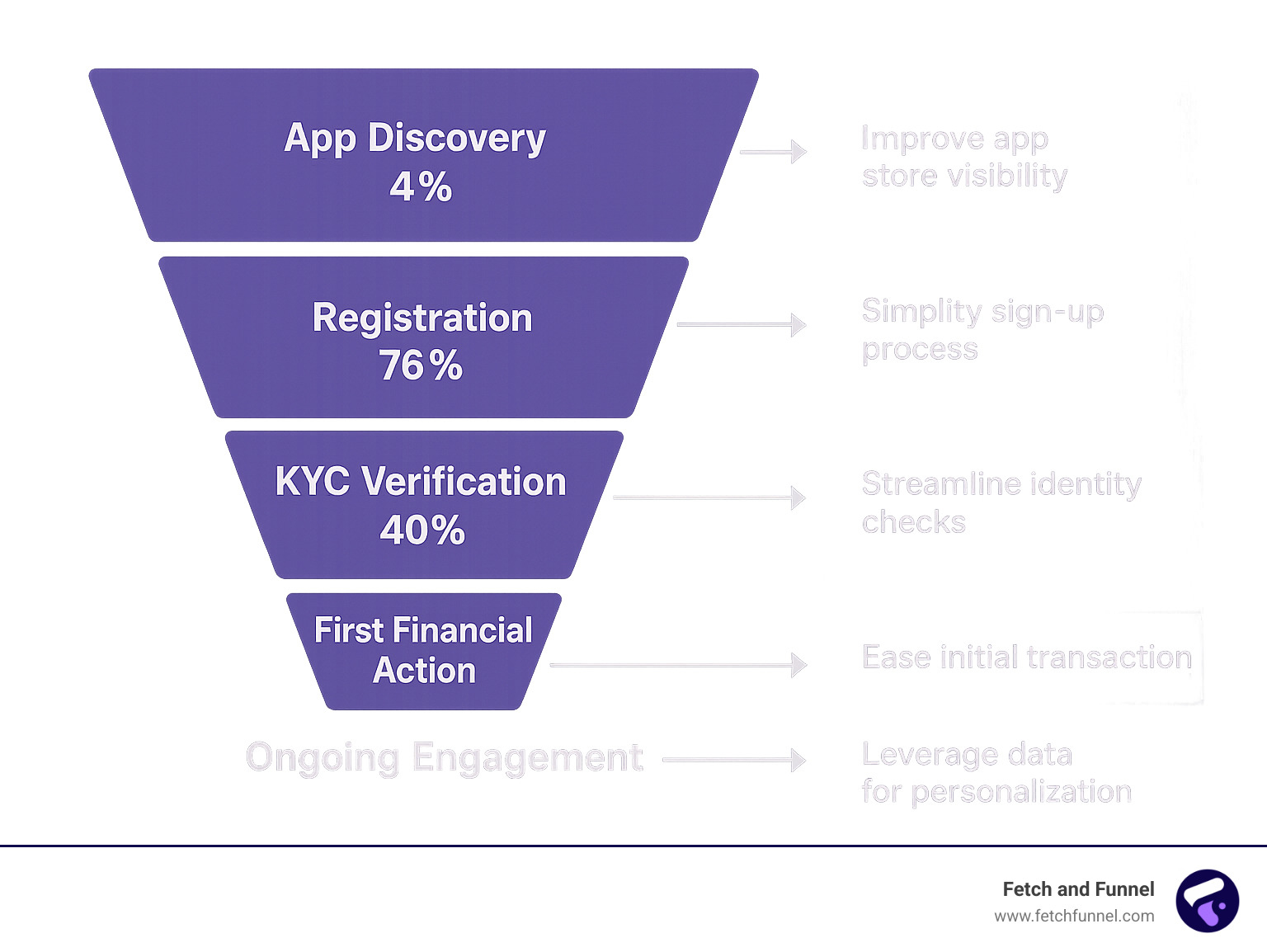
Let’s face it – fintech conversion funnels are a different beast altogether. Unlike buying a t-shirt online, getting someone to trust you with their money involves a longer, more complex journey with several make-or-break moments along the way.
When we work with fintech clients on conversion rate optimization for fintech, we always start by mapping out the entire customer journey:
- App Findy/Installation: That crucial first impression that leads to a download or website visit
- Registration: The initial account creation with basic verification steps
- KYC/Identity Verification: The compliance hurdle where users prove who they say they are
- First Financial Action: The magical moment when someone trusts you enough to move money
- Feature Adoption: When users start exploring what your platform can actually do for them
- Retention & Expansion: The ongoing relationship that determines your true success
Each of these stages tells its own story. Take KYC verification – Deloitte’s research shows this stage alone can see abandonment rates as high as 40%! That’s nearly half your potential customers walking away at a single step.
Conversion rate optimization for fintech: funnel stages & KPIs
To improve what you don’t measure is just guesswork. Here’s how we track success at each stage of the fintech journey:
For your App Findy & Installation phase, we’re looking at your impression-to-install rate (iOS finance apps average around 4%), your Google Play page view-to-install rate (which hovers around 33% for fintech), and your overall app store listing conversion.
During Registration, we track completion rates, how long it takes users to register, where they’re making errors, and exactly which form fields send them running.
The critical KYC/Identity Verification stage needs close attention to initiation rates, completion percentages, document rejection frequency, verification time, and related support tickets.
For First Financial Action, we’re watching time-to-first-transaction, bank connection success rates, initial deposit amounts, and any transaction failures that might frustrate new users.
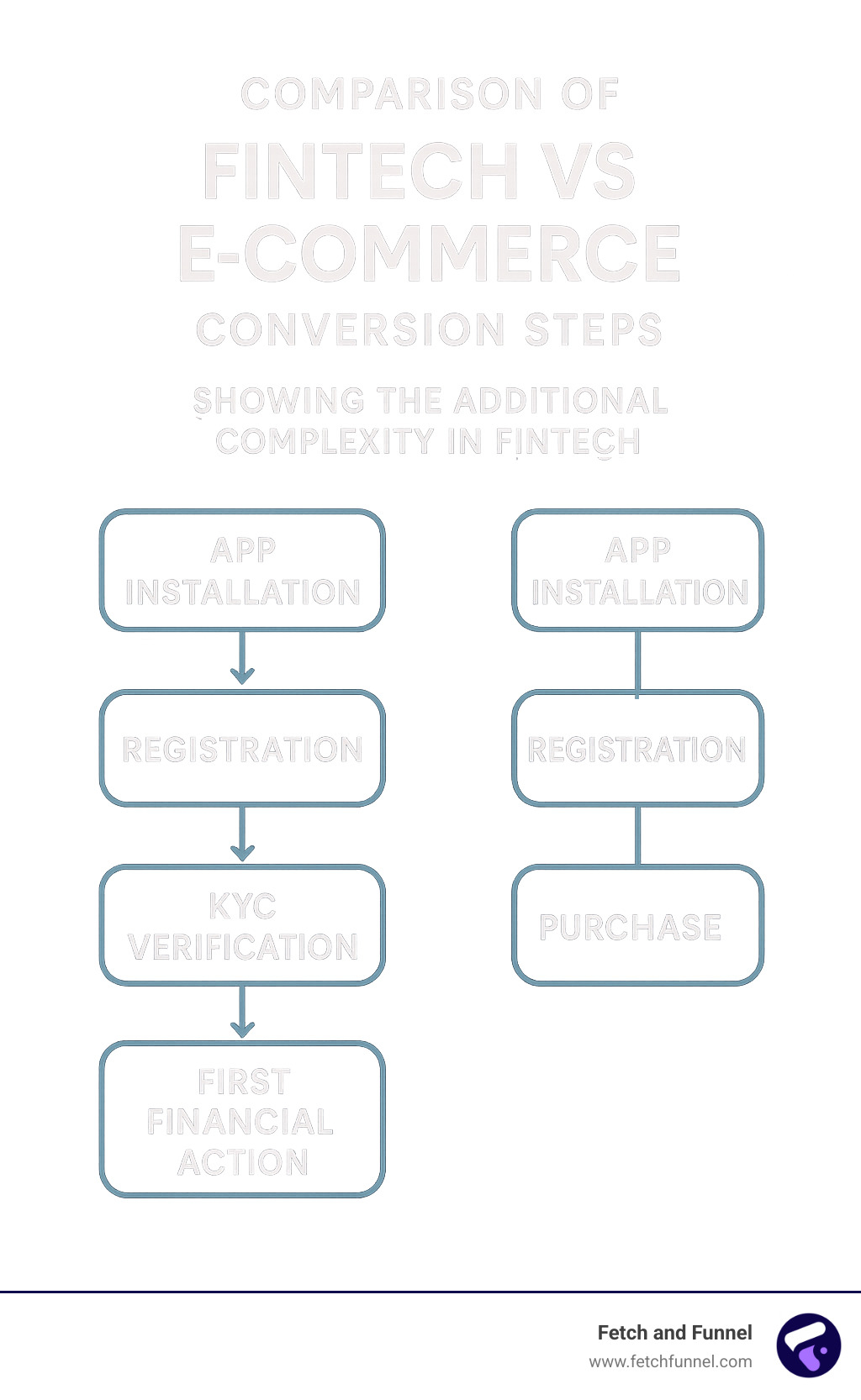
When you compare fintech to ecommerce (as our infographic shows), the journey is simply more complex. While an online store might get you from product findy to purchase in a few clicks, financial services require deeper commitment, more personal information, and greater trust. This complexity is exactly why conversion rate optimization for fintech requires specialized expertise.
Tactical Playbook: Trust, UX, Personalization, Onboarding
Let’s roll up our sleeves and dive into the strategies that actually move the needle for conversion rate optimization for fintech. These aren’t just theoretical concepts—they’re battle-tested tactics that have transformed struggling fintech platforms into conversion powerhouses.
Building credibility that converts
In finance, trust isn’t just important—it’s everything. When users are handling their hard-earned money, they need to feel secure at every step.
Think about it: would you hand over your banking details to a website that looks sketchy? Neither would your customers. That’s why prominently displaying security certificates and compliance badges (like FDIC, PCI-DSS, and SOC 2) can boost conversion rates by 15-30%. These aren’t just logos—they’re visual promises of protection.
Social proof works wonders too. Seeing that “2 million users trust us with their investments” or “Processing $5 billion in transactions monthly” helps potential customers feel they’re in good company.
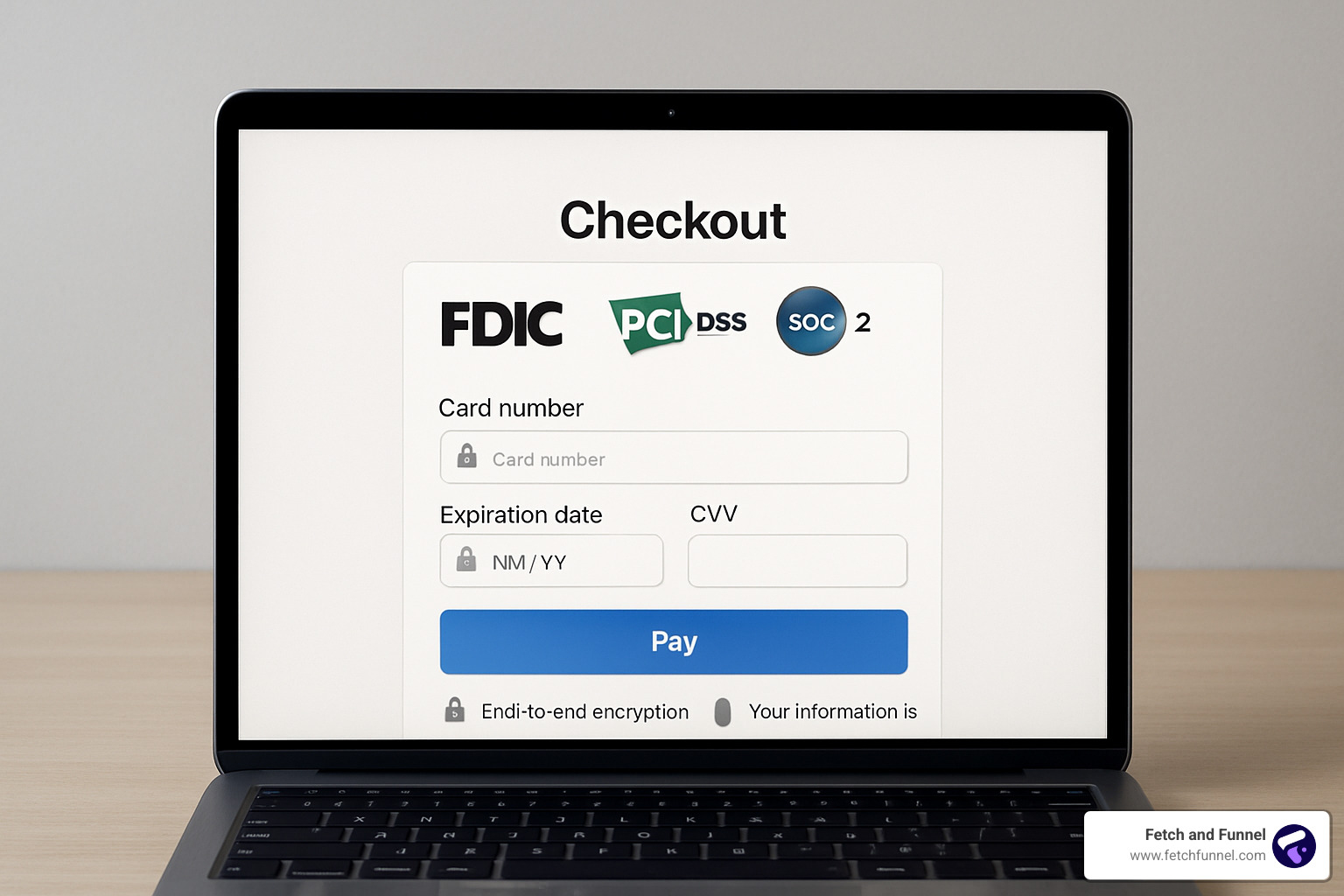
Don’t underestimate the power of real-time security indicators either. Simple visual cues like lock icons near credit card fields or “encrypted” badges during sensitive transactions provide reassurance at critical moments.
For more proven approaches that build trust and drive conversions, check out our Conversion Rate Optimization Best Practices.
Streamlining onboarding & KYC
The KYC process is often where promising fintech conversions go to die. But it doesn’t have to be that way.
Breaking the process into bite-sized steps makes a world of difference. When users see “Step 2 of 4” with a progress bar, the journey feels manageable. Even better—allowing them to save their progress and return later can recapture up to 52% of users who would otherwise abandon the process.
Forms are the backbone of fintech onboarding, but they’re also conversion killers when poorly designed. Keep them simple by asking only for essential information. Use conditional logic to show only relevant fields. Implement real-time validation so users don’t submit forms only to see a laundry list of errors.
Mobile optimization is non-negotiable for KYC. Let users snap photos of their IDs instead of uploading files. Use OCR technology to auto-fill information from those documents.
Personalization & segmentation to lift conversions
Personalization isn’t just a nice-to-have in fintech—it’s a conversion boostr. Research shows personalized CTAs perform a staggering 202% better than generic ones.
Dynamic CTAs that adapt to user behavior make a huge difference. A first-time visitor might see “Start Your Financial Journey,” while a returning user who abandoned KYC might see “Complete Your Account—Just 2 Minutes Left.”
By implementing thoughtful personalization, fintech clients have seen conversion improvements of 25-50% across various funnel stages. The key is making every user feel like your platform was built specifically for them.
For a deeper dive into how personalization can transform your conversion rates, explore our comprehensive guide on Conversion Rate Optimization Testing.
Running Data-Driven Experiments Safely in Regulated Environments
Let’s face it – testing is the heart and soul of conversion rate optimization for fintech, but when you’re handling sensitive financial data, you can’t just throw spaghetti at the wall to see what sticks. The good news? You can absolutely run meaningful experiments while keeping your compliance team happy.
Conversion rate optimization for fintech: experimentation checklist
Before you launch that shiny new test, take a breath and run through this checklist:
Start with a robust hypothesis library. Each entry should clearly document the problem you’re solving, your proposed solution, expected outcomes with specific metrics, and your rationale. This isn’t just good science – it creates a paper trail that demonstrates thoughtful intent behind each test.
Next, make sure you’ve got your sample size right. Financial decisions often have longer consideration cycles than e-commerce purchases, so you’ll need patience and proper calculations.
Choose the right test type for your goals. Simple A/B tests work great for straightforward changes, while multivariate testing lets you examine multiple elements simultaneously.
Want to dive deeper into testing methodologies? Check out our comprehensive guide on Conversion Rate Optimization Testing.
Balancing innovation with compliance
Financial services face unique regulatory constraints, but that doesn’t mean innovation has to suffer. Here’s how to thread that needle:
Build a streamlined legal review process from day one. Create standardized templates that address common compliance concerns, document everything, and nurture relationships between your optimization and legal teams.
Risk segmentation is your secret weapon. Start testing with lower-risk customer segments before rolling changes out widely. Always compare risk profiles between test and control groups, and set up automatic alerts if risk indicators exceed predetermined thresholds.
Sandbox environments provide safe spaces for bold ideas. Use staging environments that mirror production settings, implement feature flags for controlled rollouts, and consider canary releases that gradually expose new features to small user segments first.
The secret isn’t avoiding experimentation – it’s building a framework that makes compliance part of your process rather than an afterthought. When done right, conversion rate optimization for fintech becomes a competitive advantage that drives growth while maintaining trust.
Measuring Success, Tools & Continuous Improvement
Let’s talk about how to actually track and improve your fintech conversion efforts. After all, you can’t improve what you don’t measure! The right metrics and tools make all the difference between random tweaks and strategic optimization.
Essential CRO metrics & dashboards
When I work with fintech clients, I always start by establishing a clear measurement framework. Think of it as your CRO compass – helping you steer toward meaningful improvements rather than getting lost in a sea of data.
Your core conversion metrics should track the overall health of your funnel. This means monitoring your conversion rates at each funnel stage, identifying where users drop off, and measuring how long it takes users to complete key actions.
Trust indicators deserve their own tracking. How long do users spend reviewing your security information? Are they engaging with trust elements like security badges? A spike in trust-related support tickets often signals a conversion problem brewing.
User experience metrics reveal friction points in your journey. Page load time is particularly critical – remember that Google research showing how two-second load times can boost conversions by 15%?
I recommend building dashboards that give both the 30,000-foot view and the ability to drill down into specific issues. This balance helps you spot trends while still diagnosing specific problems.
Tech stack recommendations
Having the right tools makes fintech CRO infinitely more effective. Here’s what I’ve found works best:
For analytics platforms, Google Analytics 4 provides solid core website tracking, while Mixpanel or Amplitude offer deeper product analytics. Heap is particularly valuable for fintech because it automatically captures all user interactions.
When it comes to testing platforms, Optimizely remains the gold standard for enterprise-level A/B testing with robust statistical analysis. VWO offers comprehensive testing and personalization capabilities, while Google Optimize provides a good entry point if you’re just getting started.
You can explore more options in our comprehensive guide to Conversion Rate Optimization Tools.
Frequently Asked Questions about Conversion Rate Optimization for Fintech
What is a “good” fintech conversion rate?
I get this question all the time, and the honest answer is: it depends. There’s no universal “good” conversion rate for fintech because rates vary dramatically by product type, funnel stage, and market maturity.
Investment apps typically see 1-3% conversion rates, while payment apps might reach 3-5%, and lending platforms fall somewhere in between. Rather than obsessing over industry benchmarks, focus on continuous improvement of your own metrics.
How do we reduce KYC abandonment without risking compliance?
This is the eternal fintech challenge – balancing regulatory requirements with user experience. The key is progressive disclosure – only asking for information when it’s absolutely necessary. Break the process into logical stages and always explain why you need each piece of information.
Technology can be your best friend here. Implement OCR for document scanning, use biometric verification where appropriate, and always offer alternative verification methods when primary options fail.
Which CRO tools are safest for regulated financial data?
When it comes to fintech, not all CRO tools are created equal. Security and compliance must be your top priority.
Look for enterprise-grade security features including SOC 2 Type II compliance, GDPR and CCPA compliance capabilities, end-to-end encryption, and role-based access controls. These aren’t just nice-to-haves; they’re essential for protecting sensitive financial data.
Conclusion
Conversion rate optimization for fintech isn’t something you check off your to-do list and forget about. It’s a living, breathing process that requires constant attention, testing, and refinement. In the high-stakes world of financial technology, leaving conversion to chance is like leaving money on the table.
When you think about it, fintech companies face a unique challenge. You’re not just selling a product; you’re asking users to trust you with their financial future. Every form field, every security badge, every moment of hesitation in your funnel can make or break that trust.
Throughout this guide, we’ve explored the critical elements that can transform your fintech platform from a leaky bucket into a conversion powerhouse:
Start with your data story. Your conversion funnel tells a tale—where users engage, where they hesitate, and where they leave. Mapping this journey with precision gives you the roadmap for improvement.
Trust isn’t optional—it’s everything. In fintech, trust signals aren’t just nice design elements; they’re conversion essentials. Those security certificates, encryption indicators, and compliance badges aren’t just for show—they’re the digital equivalent of a firm handshake.
Simplicity conquers complexity. Breaking down intimidating processes like KYC verification into bite-sized steps with clear guidance can dramatically reduce abandonment. Remember: users don’t fear complexity as much as they fear confusion.
Personal touches matter more than you think. When you deliver experiences custom to user behavior and preferences, you’re not just improving metrics—you’re showing users you understand their unique needs.
Safe experimentation drives growth. The fintech companies seeing the biggest gains aren’t taking wild risks—they’re running thoughtful, compliant experiments with proper documentation and monitoring.
At Fetch and Funnel, we’ve walked this journey with numerous fintech companies across Boston and beyond. We’ve seen how thoughtful, data-driven optimization can transform struggling platforms into conversion machines without compromising compliance or user trust.
Ready to transform your fintech platform’s conversion performance? Learn more about our Conversion Rate Optimization services and find how we can help your financial technology business grow.