Why Most Businesses Need a Strong Lead Nurturing Process
Are you spending money to attract new leads, only to see most of them vanish? Many businesses struggle with this “leaky bucket” problem. In fact, a shocking 80 percent of new leads never convert into sales. This is where the lead nurturing process becomes your secret weapon.
When done right, lead nurturing generates 50 percent more sales-ready leads at a 33 percent lower cost. Plus, deals closing with nurtured leads have a 47 percent higher order value, and lead nurturing emails get 4 to 10 times the response rate of standalone email blasts.
This guide will show you how to build lasting relationships and turn more prospects into customers by combining strategic action with innovative tech solutions.
What is Lead Nurturing?
At its core, lead nurturing is the strategic process of building long-term relationships with potential customers. It involves engaging and educating prospects at every stage of their buyer’s journey with personalized, value-driven interactions. Instead of a hard sell, you provide value, build trust, and guide prospects until they’re ready to purchase. The goal is to establish your brand as an authority and the ideal solution to their needs.
This relationship-building fosters loyalty, leading to future upsells and brand advocacy. By focusing on cultivating deeper connections and providing consistent value, businesses can achieve more sustainable growth. To dive deeper into the basics, check out our guide on Define Lead Nurturing. For another perspective, see HubSpot’s explanation of what lead nurturing is.
Lead Nurturing vs. Lead Generation vs. Lead Qualification
It’s easy to confuse these terms, but they represent distinct stages in the customer acquisition process. Understanding their differences is crucial for a cohesive strategy.
| Feature | Lead Generation | Lead Qualification | Lead Nurturing |
|---|---|---|---|
| Purpose | Attracting potential prospects | Assessing a lead’s fit and readiness | Building relationships and guiding to purchase |
| Stage of Funnel | Top of Funnel (ToFu) | Middle of Funnel (MoFu) | Ongoing, across all stages |
| Focus | Identification and initial attraction | Evaluation of interest, budget, need, timeline | Education, trust-building, value delivery |
| Primary Goal | Fill the sales pipeline | Determine sales-readiness | Convert qualified leads into customers |
| Output | Raw leads | Marketing Qualified Leads (MQL), Sales Qualified Leads (SQL) | Paying customers, loyal advocates |
Lead generation is the first step: identifying and attracting potential prospects through content marketing, SEO, or paid ads.
Next, lead qualification evaluates whether a lead is a viable prospect. This process determines if they are a Marketing Qualified Lead (MQL), who has engaged with marketing content, or a Sales Qualified Lead (SQL), who shows higher purchase intent and meets sales criteria.
Finally, the lead nurturing process is the continuous engagement with these prospects, guiding them through the sales funnel at their own pace. It bridges the gap between initial interest and purchase, ensuring leads don’t go cold. While lead generation fills the funnel and qualification refines it, nurturing is what turns prospects into customers.
The 4 Key Stages of the Lead Nurturing Process

Think of the lead nurturing process as a guide walking alongside your prospects. Every potential customer goes through predictable stages before making a purchase, and understanding these stages is key to success. They start with a problem, research solutions, evaluate options, and finally make a decision. The magic happens when you provide exactly what they need at each stage.
This strategic alignment between your content and their mindset is called content mapping. It’s how we guide leads toward a purchase decision without being pushy. For a broader view, check out our guide on the Digital Marketing Funnel, or see how Mailchimp approaches the marketing funnel.
Stage 1: Awareness
In the awareness stage, prospects first realize they have a problem that needs solving. They aren’t shopping for products yet; they’re trying to understand what’s wrong. They might be googling symptoms, reading about industry trends, or asking colleagues about similar issues.
Your goal is to help them identify and articulate their prospect pain points. Your awareness-stage content should be educational and problem-focused. Blog posts exploring common challenges, social media updates with industry insights, infographics, and checklists all work well here. The key is providing value without a product pitch.
Stage 2: Consideration
Now your prospect knows what’s wrong and is ready to explore how to fix it. They’ve moved from “What’s my problem?” to “What are my options?” In this consideration stage, they are researching different approaches and methodologies.
Prospects are reading comparison articles, attending webinars, and downloading white papers. They want to understand what solutions exist and which might be best for their situation. Your content strategy shifts to solution-oriented education. This is where you showcase your expertise by explaining how your type of solution works and sharing case studies. You’re still not pushing your specific product—you’re educating them about the solution category. White papers, comparison guides, and expert guides help prospects feel confident.
Stage 3: Decision
Your prospect has done their homework and knows what type of solution they want. Now they ask, “Who should I buy from?” In the decision stage, they’re evaluating specific vendors and looking for reasons to choose you.
This stage is about building confidence and trust. Prospects are looking for proof that you’re the right partner. Your content becomes highly targeted and persuasive. Product demos let them see your solution in action, free trials remove risk, and customer testimonials provide social proof. Detailed pricing pages and one-on-one consultations are also valuable here, where your Conversion Optimization expertise can make all the difference.
Stage 4: Post-Purchase & Advocacy
Many businesses mistakenly think the lead nurturing process ends at the sale. In reality, some of the most important nurturing happens after. This stage is about turning customers into fans who stick around and tell others about you.
New customers need reassurance and support to feel confident about their purchase. This is your chance to exceed expectations and create loyalty. Post-purchase nurturing focuses on success and relationship building. Smooth onboarding, proactive customer support, and loyalty programs are key.
Happy customers can become your best salespeople, creating loyal brand advocates. This stage is also ripe for growth opportunities, as satisfied customers are more likely to buy additional products or upgrade. To maximize this stage, focus on improving your Customer Engagement Strategies.
7 Actionable Lead Nurturing Strategies and Tactics

Now that we understand the customer journey, let’s dive into the practical tactics behind a successful lead nurturing process. It’s about providing helpful, meaningful communication that guides leads forward. This is smart business: lead nurturing emails get 4 to 10 times the response rate compared to one-off blasts.
For a comprehensive guide, see our resource on How to Nurture Leads.
1. Create Targeted Content for Each Stage
The secret to a winning lead nurturing process is delivering the right message at the right time. This means matching your content to each step of a prospect’s journey and their unique needs. We call this content mapping. For example, a new lead might get a blog post about industry challenges, while a lead ready to decide gets a case study. This focus on value-driven content is critical; 56 percent of marketers say targeted content is the most important part of their nurturing strategy. To truly resonate, your content must be relevant to your leads.
2. Use Multi-Channel Nurturing
Your prospects are active on multiple platforms. While email is a superstar, an effective lead nurturing process reaches out across various channels to keep your brand top of mind. We weave together different touchpoints to create a seamless experience. This could mean a stream of insights through email marketing, engagement on social media, or gentle reminders with paid retargeting ads. For more on this, check out What is Retargeting in Marketing and our Best Retargeting Practices. We might also use SMS marketing or direct mail for a personalized touch.
3. Leverage Personalization at Scale
Today’s customers crave experiences that feel personal; in fact, they often feel frustrated when content isn’t. Personalization is a cornerstone of our lead nurturing process. We go beyond just using a first name, leveraging technology to make every interaction feel unique. This includes dynamic content on your website that changes based on visitor behavior, or behavioral triggers that send a message after a specific action. We also craft personalized subject lines and acknowledge past interactions to show we’re paying attention. This level of care builds a strong foundation of trust.
4. Implement Timely and Automated Follow-ups
Automation is the secret sauce for a scalable and consistent lead nurturing process. It ensures no lead falls through the cracks and that your messages arrive at the right moment. We set up smart, automated sequences that work in the background. This includes drip campaigns (pre-scheduled emails), a warm welcome series for new leads, and abandoned cart emails to recover near-sales. These systems free up your team to focus on high-value conversations. Our Automated Lead Nurturing and AI Marketing Automation solutions are designed to make this simple.
5. Align Sales and Marketing Teams
If your sales and marketing teams aren’t on the same page, leads can easily get lost. For a powerful lead nurturing process, these teams must be in sync, sharing insights and working towards common goals. We help bridge gaps by establishing clear communication. This often involves creating a Service Level Agreement (SLA), which outlines shared goals, defines a “sales-ready” lead, and sets expectations for handoffs. HubSpot offers a great template and guide for creating your own SLA. When marketing and sales work together, messaging stays consistent and you maximize your chances of conversion.
6. Nurture with Video Content
Video is an incredibly engaging and easy-to-digest format, making it a powerhouse in your lead nurturing process. It lets you explain complex ideas, build a personal connection, and show off your brand’s personality. Use engaging product demos, informative webinars, or authentic customer testimonials. We can also use behind-the-scenes or explainer videos to simplify concepts. Since mobile devices account for at least 50 percent of web traffic, we always ensure your video content looks fantastic on any screen.
7. Re-engage Dormant Leads
Not every lead is ready to buy right away, and some may go quiet. A smart lead nurturing process always includes a plan to re-engage these dormant leads. We work to bring them back with clever strategies, such as reactivation campaigns, special offers, or surveys to understand why they disengaged. We can also share new feature announcements that might make your offering newly relevant. Our AI Reactivation Campaigns use smart technology to target these leads effectively and open up their hidden potential.
Tools and Technology: The Engine of Your Nurturing Strategy
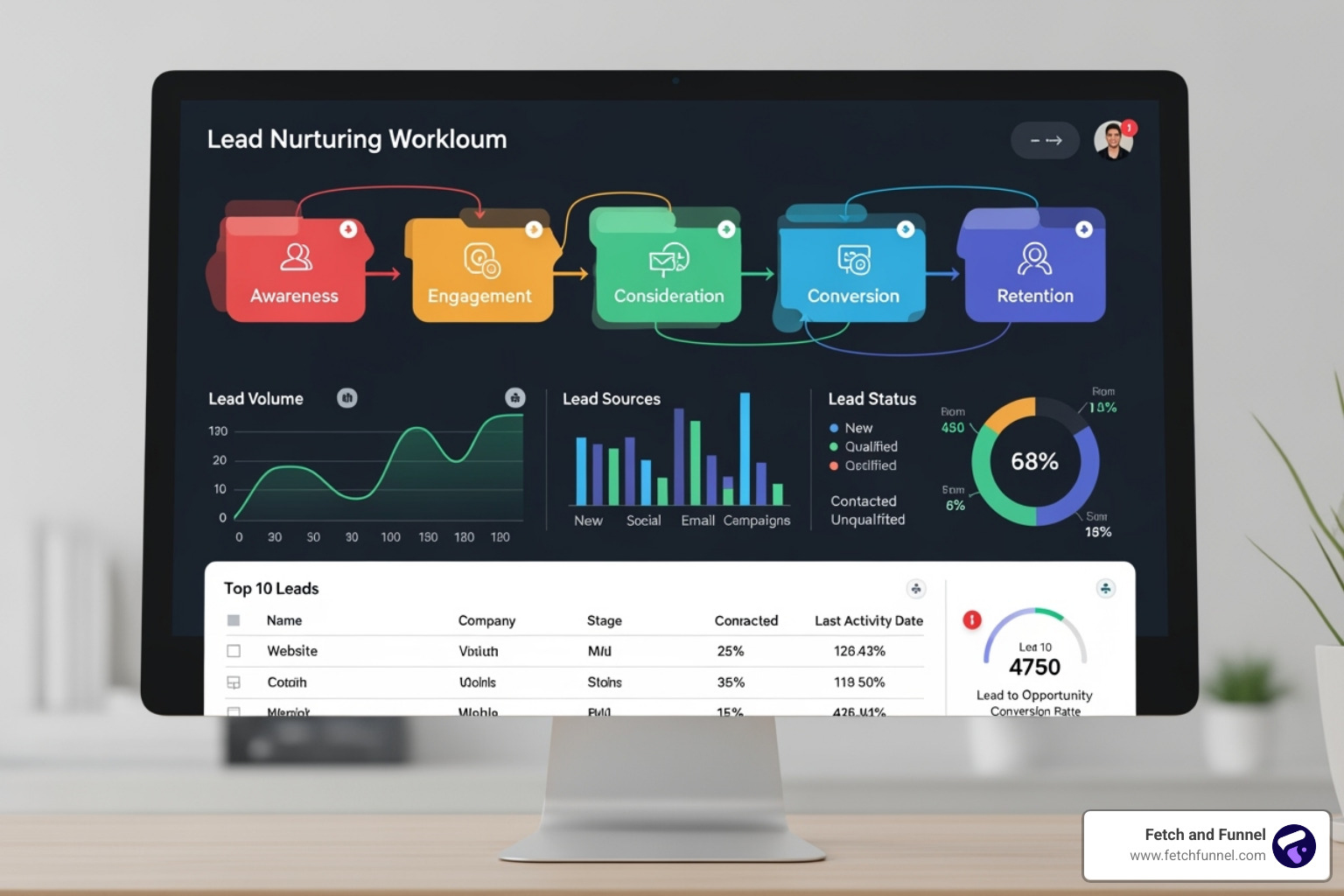
While strategy is the heart of the lead nurturing process, technology is its engine. The right tools empower you to automate, personalize, track, and optimize your efforts at scale. A robust CRM, for example, can help increase sales by up to 29 percent.
The Role of CRM and Marketing Automation
Customer Relationship Management (CRM) systems and marketing automation platforms—like HubSpot, Salesforce Pardot, and ActiveCampaign—are the twin pillars of a successful lead nurturing process. They provide a single source of truth for all prospect data, allowing for precise audience segmentation and information sharing across teams. These platforms automate workflows like drip campaigns based on lead actions, ensuring timely communication. They also track every interaction a lead has with your brand, providing invaluable insights and comprehensive reporting to make data-driven decisions.
Essential features in a lead nurturing tool:
- Contact management and segmentation
- Email marketing automation and drip campaigns
- Behavioral tracking and lead scoring
- Integration with sales tools
- Analytics and reporting dashboards
- Customizable workflows and triggers
At Fetch & Funnel, we leverage powerful CRM and marketing automation solutions to build sophisticated lead nurturing programs. Explore our Fetch & Funnel’s CRM and automation solutions to see how we can streamline your efforts.
Optimizing your lead nurturing process with lead scoring
Lead scoring is a critical methodology used to rank prospects on a scale that represents their value and readiness to buy. By assigning points to various attributes and behaviors, we can prioritize our efforts.
- Demographic Scoring: Points assigned based on characteristics like industry, company size, or job title.
- Behavioral Scoring: Points assigned based on actions taken, such as website visits, content downloads, or email clicks.
The higher a lead’s score, the “hotter” they are. This allows the sales team to focus their energy on the most promising prospects. Lead scoring also helps determine the ideal moment for a marketing-to-sales handoff, improving conversion rates by ensuring sales engages leads when they are most receptive to scientifically determining buying intent.
Measuring and Improving Your Lead Nurturing Campaigns
An effective lead nurturing process isn’t a “set it and forget it” operation. It requires continuous measurement, analysis, and optimization. We believe in making smart, data-driven decisions to refine strategies and achieve better outcomes. This approach delivers real results, generating 50 percent more sales-ready leads at a 33 percent lower cost. A clear performance dashboard is vital for this ongoing success.
Ready to see how we track and boost your sales pipeline? Our AI Sales Funnel Optimization services are designed to do just that.
Key Metrics to Track for Success
To understand the pulse of your lead nurturing process, we track a variety of Key Performance Indicators (KPIs). These metrics tell a story about your leads’ journey and where we can make improvements.
We monitor engagement metrics like email open/click-through rates, website visits, and content downloads to gauge interest. We also analyze conversion rates by stage, measuring the percentage of leads moving from Marketing Qualified Lead (MQL) to Sales Qualified Lead (SQL), and finally to a customer. Other key metrics include time to conversion, the overall sales cycle length, and Customer Lifetime Value (CLV), which is often higher for nurtured leads. We measure Marketing ROI to confirm the profitability of your nurturing efforts.
By consistently monitoring these crucial metrics, we can pinpoint what’s working, what needs a tweak, and where opportunities for improvement lie.
How to A/B Test and Optimize Your Campaigns
Optimization is a continuous journey of testing, learning, and refining. A/B testing is our primary tool, allowing us to compare different versions of your nurturing elements to see which performs better.
We can test various components within your campaigns. For emails, this might mean trying different subject lines or Calls-to-action (CTAs). We’ll also test different content offers (e.g., a whitepaper vs. a checklist) to see what resonates at specific stages. Even the send times of your emails and the landing page design can be A/B tested to find the optimal combination for maximum engagement.
By systematically testing these variations and implementing the winners, we continuously improve the effectiveness of your entire lead nurturing process. While most email platforms have built-in A/B testing, dedicated tools like Optimizely or VWO offer more advanced capabilities for landing pages and websites. This is a core part of our commitment to driving growth, powered by our Conversion Rate Optimization Services.
Frequently Asked Questions about the Lead Nurturing Process
It’s natural to have questions when diving into the lead nurturing process. Let’s tackle a few of the most common ones to help you feel more confident about your strategy.
How long should a lead nurturing campaign be?
There’s no one-size-fits-all answer. The ideal length for your lead nurturing process depends heavily on your sales cycle length, the complexity of your product, and the lead’s initial temperature. For simpler products, a campaign might last 6 to 45 days. For high-ticket items or complex B2B solutions, nurturing could extend for several months. The goal is to align your campaign’s pace with your buyer’s natural journey, staying top-of-mind without being pushy.
How many “touches” does a lead need?
There’s no single magic number of “touches” (or interactions) a lead needs. However, multiple touchpoints are crucial. Research often suggests around ten marketing touches from first interaction to conversion, though some, like Salesforce, suggest it can be 6-8 touches. The secret is to focus on value over volume. It’s not just how many times you reach out, but how helpful and relevant each interaction is. Your goal should be meaningful engagement, not just frequent contact.
Can you over-nurture a lead?
Yes, it’s possible to cause “communication fatigue.” Signs you might be over-nurturing include a jump in unsubscribe rates or consistently low engagement metrics. To avoid this, monitor engagement levels closely. If a lead isn’t interacting, consider pausing, trying a less frequent nurturing track, or moving them to a re-engagement campaign. Providing clear opt-out options is also key, as it shows you respect their inbox. The golden rule is to focus on relevance and timing, ensuring every interaction adds value.
Conclusion: Turn Your Leads into Lasting Customers
We’ve journeyed through the entire lead nurturing process, from understanding why leads slip away to exploring practical strategies and the tools that make it happen. It’s clear that lead nurturing is a fundamental shift in how businesses connect with potential customers.
Today’s buyers are smart, do their own research, and move at their own pace. By embracing a strategic, value-driven approach to nurturing, you’re not just sending emails; you’re building bridges. This allows you to:
- Build genuine trust: Become a reliable, knowledgeable advisor.
- Increase conversions: Thoughtfully guide more prospects into actual sales.
- Maximize your ROI: Stop wasting money on leads that vanish.
- Foster lasting relationships: Turn one-time buyers into loyal brand advocates.
Here at Fetch & Funnel, based right outside of Boston, MA, we specialize in crafting sophisticated, data-driven lead nurturing process strategies that transform your leads into long-term customers. Our expertise in full-funnel advertising, creative strategy, and conversion rate optimization means your efforts will be remarkably profitable.
Ready to fix that “leaky funnel” and ensure your hard-earned leads never go to waste? As your trusted Full Funnel Marketing Agency, we’re ready to help you achieve sustainable growth. Reach out to us, your dedicated Lead Generation Marketing Agency, and let’s get started!